
Beating Decision Fatigue: A Founder's Guide
How to reduce low-value decisions, protect judgment, and build a decision system that scales with the business.
Founders make decisions all day. Pricing. Hiring. Client problems. Marketing. Product. Cash flow. Offers. Meetings. What deserves attention now and what can wait.
By late afternoon, it can feel like your brain has stopped cooperating. That experience is real.
But the popular explanation — that every decision drains a fixed pool of willpower until you eventually run out — is much less certain than productivity culture makes it sound.
The more useful way to think about decision fatigue is this:
Your decision system gets worse when too many choices are complex, poorly structured, interrupted, ambiguous, or unnecessarily routed through you.
That is good news, because it means you do not need to "build more willpower." You need better decision architecture.
You do not need fewer important decisions. You need fewer decisions pretending to be important.
The Short Answer
If you are constantly tired of making decisions, start here:
The goal is not to avoid thinking. It is to stop spending founder-level attention on low-value choices.
What Decision Fatigue Actually Means
"Decision fatigue" is useful shorthand, but it is not a diagnosis and it is not a proven daily depletion meter. Researchers use the term to describe possible changes in decision behavior after sustained or repeated decision-making.
That can look like:
- Defaulting more often
- Postponing decisions
- Using shortcuts or simplifying choices
- Becoming less willing to compare options
- Disengaging from effortful analysis
But those behaviors are not necessarily caused by decisions themselves. They can also be influenced by:
- Sleep loss
- Interruptions
- Workload
- Stress and time pressure
- Hunger or boredom
- Unclear information or shifting incentives
- Task complexity
That distinction matters.
A high number of easy choices is not automatically worse than a small number of difficult, ambiguous, high-stakes ones.
The "Limited Willpower" Story Is Too Simple
For years, a popular theory suggested that self-control worked like a muscle. Use it too much, and it gets depleted. That idea became known as ego depletion.
Early studies appeared to support it. Later, larger preregistered studies found effects ranging from essentially zero to very small. That does not mean mental fatigue is imaginary. It means this claim is too strong:
Myth
"Every decision drains the same mental fuel tank."
Better Model
"Sustained cognitive demand, poor structure, interruptions, stress, and complexity can make difficult decisions harder."
After sustained difficult work, people may become less willing to invest effort, more sensitive to the perceived cost of thinking, less attentive, or more likely to simplify. That is very different from having a literal "decision battery."
What the Research Does Support
Sustained cognitive work can create fatigue
Demanding mental work can make people feel more fatigued and, under some conditions, can affect attention, response speed, persistence, error rates, working memory, and decision consistency. The effect depends heavily on the task and environment.
Interruptions matter
This is one of the strongest founder-relevant findings. Interruptions and context switching can disrupt working memory and make it harder to resume complex tasks accurately. That matters when you are:
- Reviewing a contract
- Evaluating a hire
- Working through financials
- Negotiating a deal
- Solving a client escalation
- Making pricing changes or analyzing a major investment
Complex decisions deserve a different environment than Slack, email, phone calls, and meetings.
Choice overload is conditional
More options are not automatically bad. Choice overload becomes more likely when options are difficult to compare, preferences are unclear, the stakes are meaningful, information is technical, there are too many attributes, or the decision maker wants a fast answer.
That means "give yourself fewer options" is incomplete advice. The better version: make the options easier to compare.
Why Founder Work Creates So Much Decision Load
Founder work is unusually decision-heavy because so many problems are poorly structured. You rarely get complete information, perfect forecasts, one obvious answer, unlimited time, or zero downside risk.
Instead, you get:
- Incomplete data
- Competing priorities
- Uncertain outcomes
- Constant interruptions
- Multiple stakeholders
- Decisions that arrive before you are ready
That creates cognitive load. The bigger problem, though, is structural:
The biggest problem is not that founders make many decisions. It is that too many decisions remain founder decisions.
Step 1: Remove Decisions That Should Not Exist
Before improving your decision-making, remove unnecessary decisions.
- Instead of deciding every week when to hold a team meeting, use a recurring calendar slot.
- Instead of reconsidering your pricing floor for every proposal, define a minimum margin.
- Instead of debating which projects qualify, create acceptance criteria.
- Instead of manually approving every recurring expense, establish thresholds.
If the same low-value decision keeps appearing, turn it into a rule.
Step 2: Turn Repeated Decisions Into Defaults
Defaults are one of the simplest ways to reduce unnecessary complexity. Founder-friendly examples include:
- Standard meeting lengths
- Recurring meal options
- Default project templates and payment terms
- Standard proposal structure
- Preferred communication channels
- Preapproved vendor limits
- Standard travel routines and default calendar blocks
A good default does not remove flexibility. It removes the need to start from zero.
Step 3: Separate Reversible From High-Stakes Decisions
One of the biggest founder mistakes is treating every decision as equally important. They are not.
Reversible Decisions
Easy to change, lower downside, faster cycle.
- Landing page test
- Meeting cadence
- Workflow change
- Email sequence
Hard-to-Reverse Decisions
Higher consequence, greater downside, deserve structure.
- Senior hire
- Partnership
- Acquisition
- Major lease
- Capital commitment
Hard-to-reverse decisions deserve written assumptions, explicit criteria, downside analysis, independent review, and more protected thinking time.
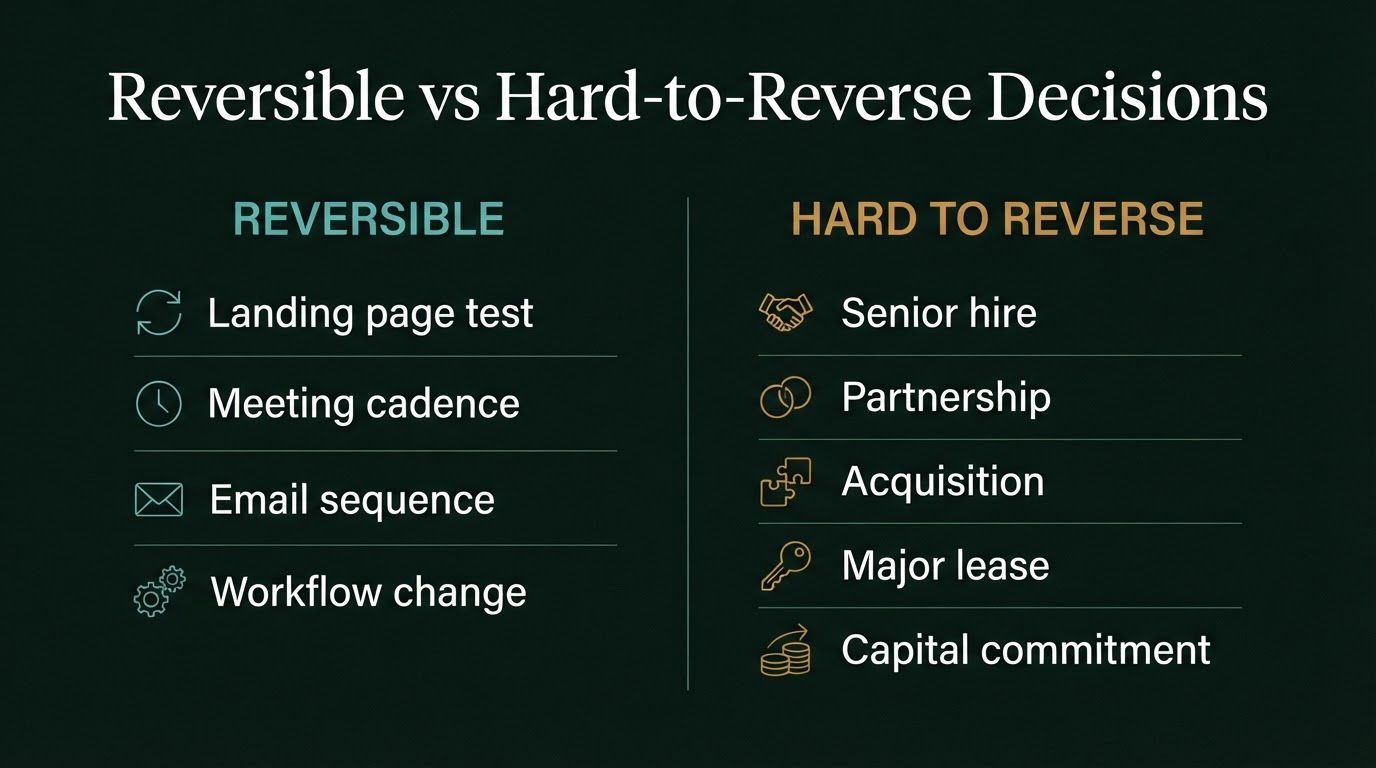
Do not spend acquisition-level thinking on reversible choices.
Step 4: Batch Low-Value Decisions
Batching can help when it reduces context switching.
- Approve routine expenses twice a week
- Review low-priority requests together
- Process administrative questions in one block
- Schedule content approvals together
- Review minor vendor decisions at the same time
The point is not to save willpower. It is to reduce switching overhead.
Step 5: Delegate Decisions That Do Not Require Founder Judgment
Delegation is not simply about getting work off your plate. It is about moving decisions to the person closest to the information. A better question than "Can someone else do this?" is:
Does this decision actually require my judgment?
Create decision rights. Define:
- Who owns the decision
- What they can approve
- What thresholds trigger escalation
- What information must be documented
- When founder review is required
Delegation without clear decision rights creates rework. Delegation with rules creates speed.
Step 6: Protect High-Quality Decision Windows
There is no strong evidence that every important decision must happen in the morning. That is another productivity myth that oversimplifies the research. A better rule: make consequential decisions when you are rested, focused, and least interrupted.
Protect that window from:
- Slack
- Meetings
- Notifications
- Casual questions and low-value approvals
The important variable is not the clock. It is the operating condition.
Use a One-Page Decision Brief
For difficult decisions, externalize the thinking. Do not try to hold everything in working memory. A one-page decision brief can include:
This is especially useful for hiring, pricing, partnerships, acquisitions, capital allocation, and major client decisions.
What Founders Usually Get Wrong
Wrong: Trying to eliminate every decision
Better: Remove low-value noise
Wrong: Treating every decision as urgent
Better: Separate urgency from importance
Wrong: Assuming more options always improve decisions
Better: Make options easier to compare
Wrong: Delegating without decision rights
Better: Define ownership and escalation rules
Wrong: Making every hard decision early because willpower is strongest
Better: Decide when rested, focused, and least interrupted
Wrong: Blaming every bad afternoon decision on decision fatigue
Better: Check sleep, stress, interruptions, workload, and information quality
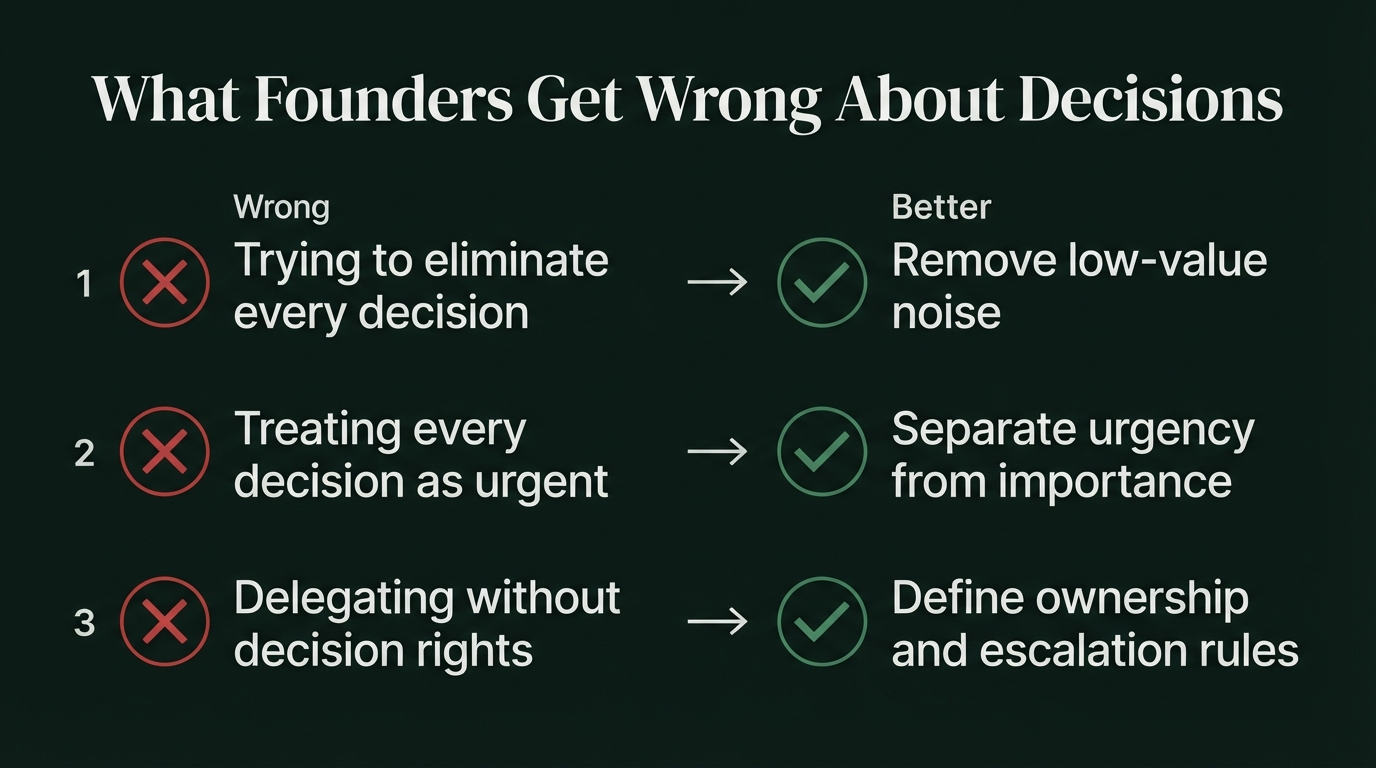
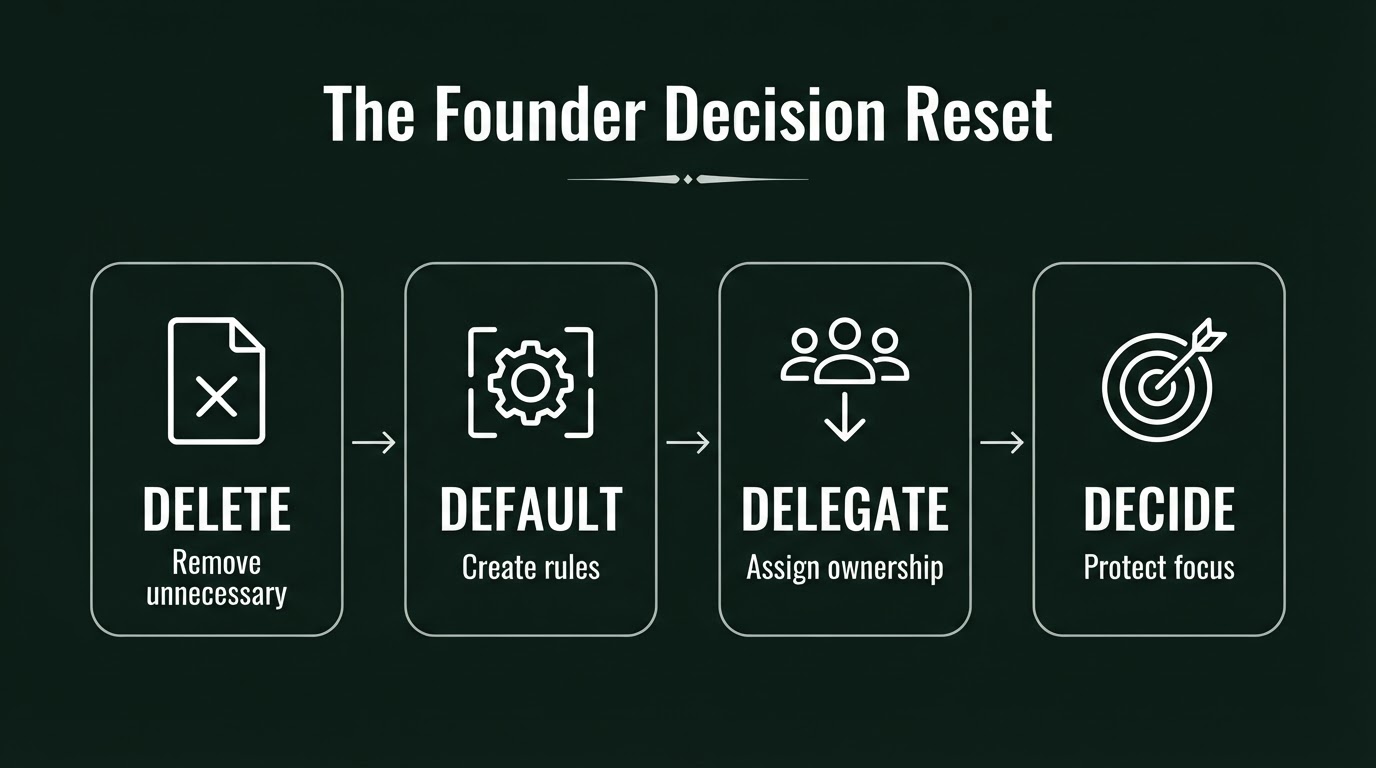
A Practical Founder Decision Reset
If your brain feels overloaded, use this quick reset.
- 1
Stop incoming decisions
Mute notifications and close communication channels temporarily.
- 2
List every open decision
Get it out of your head and onto paper.
- 3
Sort them
Use four buckets: delete, default, delegate, decide.
- 4
Identify reversibility
Can this be changed later without major damage? If yes, move faster. If no, slow down.
- 5
Pick one consequential decision
Protect a focused block for it.
- 6
Write the criteria
Do not rely on vague intuition alone.
- 7
Set a deadline
Open decisions consume attention. Close them deliberately.
A Simple Decision Architecture for Founders
Think of your decisions in four levels.
| Level | Type | Example | Approach |
|---|---|---|---|
| 1 | Routine | Scheduling, minor approvals | Default or automate |
| 2 | Reversible | Marketing tests, workflow changes | Decide quickly |
| 3 | Significant | Hiring, pricing, contracts | Use written criteria |
| 4 | Hard to reverse | Acquisitions, partnerships, major capital | Protect focus + independent review |
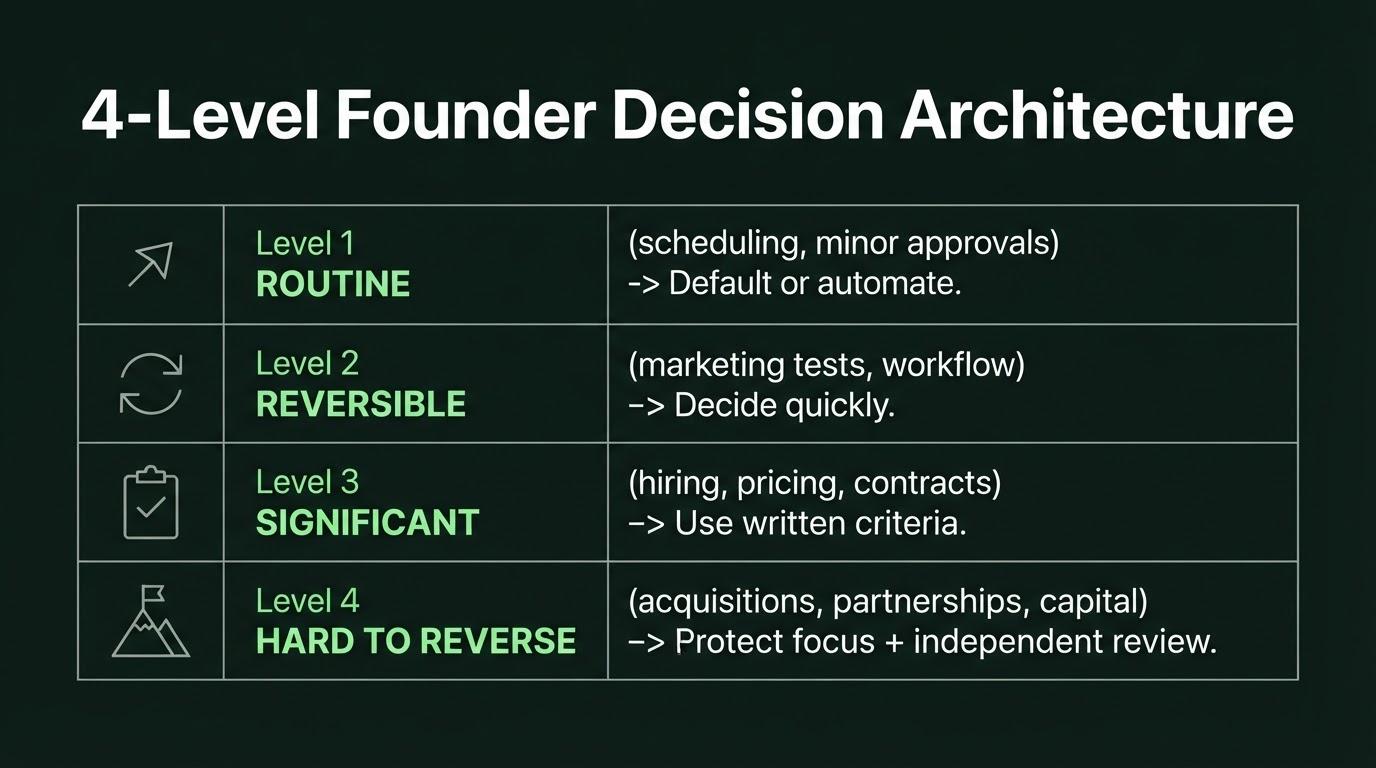
That is a much more useful system than trying to count how many decisions you have left in the day.
When the Real Problem Is Not Decision Fatigue
Sometimes the problem is simply exhaustion. If you are:
- Sleeping five hours
- Working through meals
- Constantly interrupted
- Overloaded with meetings
- Chronically stressed
- Running multiple high-stakes projects
- Trying to hold every decision personally
Then you do not necessarily need another productivity framework. You may need:
- Sleep and recovery
- Fewer interruptions
- Clearer ownership
- Better information
- Fewer concurrent priorities
That is why Green Hustler treats decision quality as part of sustainable performance, not just productivity. If your sleep is breaking down because your workday never shuts off, read how entrepreneurs can sleep better next.
Sometimes the problem is not decision fatigue. It is exhaustion.
The Founder Takeaway
Decision fatigue is useful as a practical concept. It is not a reason to believe your brain has a fixed daily supply of decisions. The more defensible lesson is:
- Reduce unnecessary choices
- Improve information design
- Create defaults
- Delegate with clear decision rights
- Batch low-value approvals
- Protect focus for high-stakes decisions
- Externalize complexity
- Fix sleep and workload when those are the real problem
You do not need fewer important decisions. You need fewer decisions pretending to be important.
Build a system where founder judgment is reserved for the decisions that actually deserve it.
FAQ
Feeling mentally overloaded?
Sometimes the problem is not decision architecture. It is a deeper capacity problem. If exhaustion is starting to look more like burnout, check the signs before adding another framework.
Note: This article is for educational purposes and is not medical advice. If you are experiencing persistent exhaustion, low mood, or cognitive issues affecting daily functioning, talk to a qualified healthcare professional. Read our full Medical Disclaimer.