
How Entrepreneurs Can Sleep Better
Sleep is usually a work-shutdown problem. Here is how to fix the open loops keeping you awake.
If you run a business, the hard part of sleep is rarely sleep itself. It is unfinished work.
Loose decisions, late Slack messages, unresolved cash flow questions, and tomorrow's pressure can keep your system switched on long after you close the laptop.
A lot of founders try to solve that with a better mattress, supplements, or another recovery tool. Sometimes that helps. Often, the real issue is that work never got a clean ending.
You do not need a perfect evening routine. You need a repeatable way to tell your brain the workday is over.
That matters because ambition is not the problem. An open-loop workday is. A few practical changes can make a real difference:
- Set a hard cutoff for non-urgent decisions
- Move tomorrow's priorities out of your head and onto paper
- Stop checking founder channels from bed
- Build a short shutdown routine you can follow even after a long day
None of this is complicated. The tradeoff is that it requires more discipline earlier in the evening, not just better intentions once you are already tired.
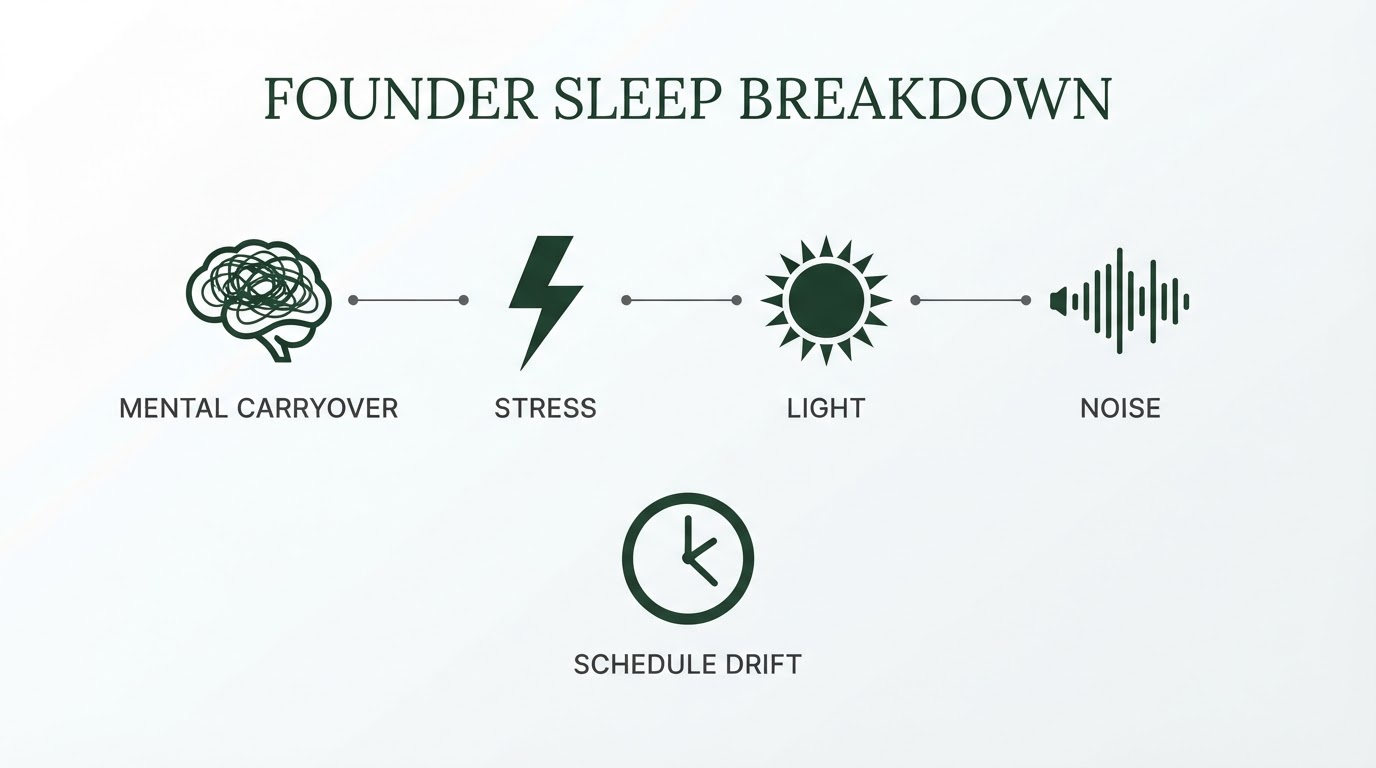
Why Founders Lose Sleep
For most entrepreneurs, sleep problems are not just about being busy. The real issue is that your brain stops treating work like work and starts treating it like survival. Payroll, client pressure, a hiring mistake, a missed launch target, or a cash flow gap next month do not feel abstract when the business depends on your decisions.
So even when you are physically tired, your mind stays on. It keeps scanning, sorting, and running scenarios. That is why you can be exhausted and still lie awake thinking about one Slack message, one invoice, or one conversation you need to have tomorrow.
The Business Feels Personal Because It Is
Founders do not clock out the way employees do. You carry revenue, team stability, reputation, delivery, and growth at the same time. That responsibility does not stay neatly inside work hours. It follows you into dinner, weekends, and bed.
That creates a specific kind of stress:
- Wins feel brief
- Problems feel persistent
- Setbacks feel personal
- Unfinished decisions keep pulling for attention
If the company is an extension of you, your nervous system rarely gets a clean signal that the day is over.
Uncertainty Keeps Your Brain Switched On
Entrepreneurship comes with constant unknowns. Maybe sales are uneven. Maybe a client is slow to pay. Maybe the market moved. Maybe the plan that worked last quarter no longer fits. When the ground keeps shifting, your brain naturally looks for control.
At night, that often shows up as rumination:
- Replaying conversations
- Rehearsing tomorrow's decisions
- Mentally rebuilding the plan at 1:00 a.m.
- Trying to solve strategic problems from bed
Late-night thinking often feels urgent. It is rarely your clearest thinking.
Start by Creating a Real Shutdown
If sleep is getting worse, do not start with self-blame. Start with a better question: what is still active in the system when the day ends?
For many founders, poor sleep is less a motivation problem than a load-management problem. Once you see that clearly, the next move is to build a cleaner shutdown.
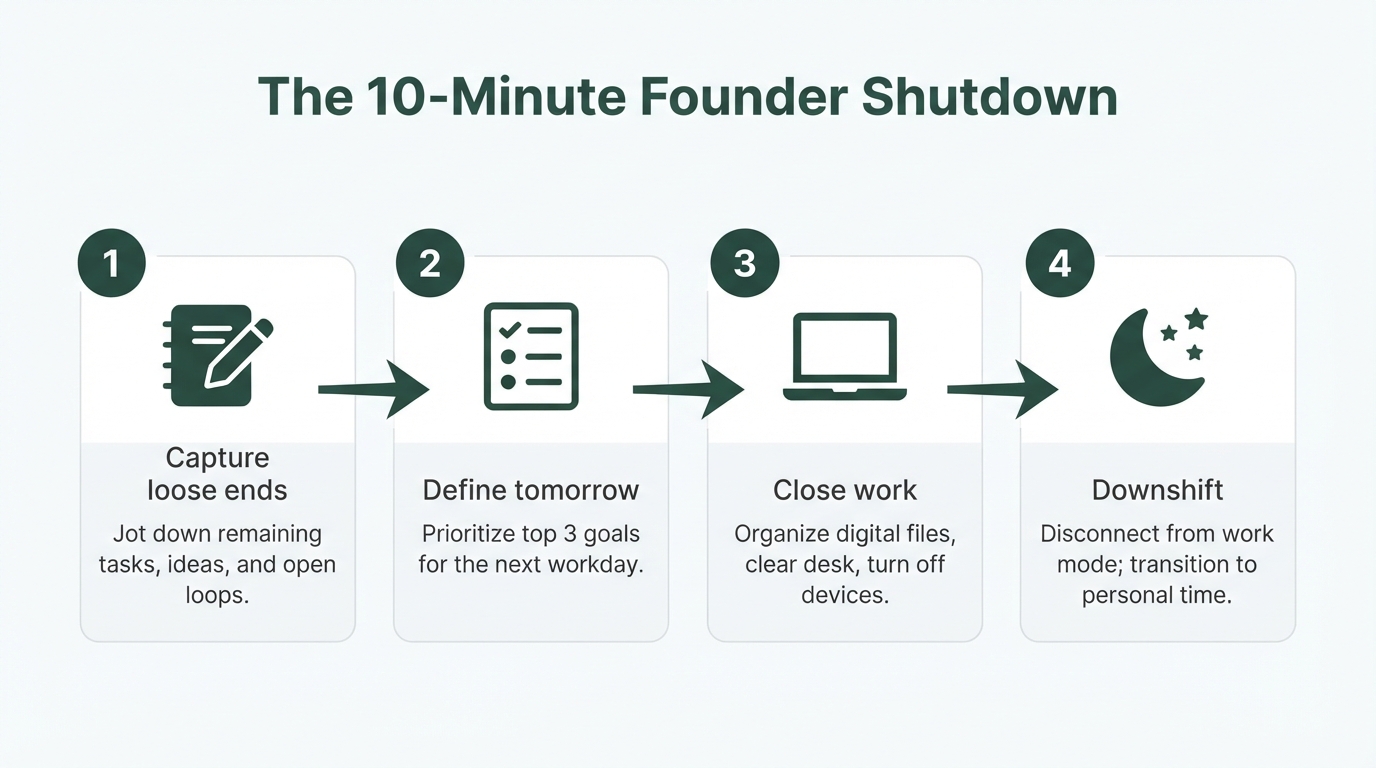
A good work shutdown can be simple:
- Review what is still open
- Choose your top one to three priorities for tomorrow
- Write the first next step for each
- Capture anything you do not want to keep mentally holding
- Close the tools you do not need overnight
This matters because open loops create mental drag. If tomorrow's priorities are stored somewhere trusted, your brain has less reason to rehearse them all night.
Stop Late-Night Work Without Falling Behind
Late-night work often looks responsible. It can even feel productive in the moment. But as a default system, it usually creates worse decisions, slower thinking, and a workday that never fully resets. You are often not fixing output. You are extending friction.
What Usually Makes Late Work Spiral
Common drivers include:
- Too many open loops across Slack, email, and meetings
- No clear priority list before reactive work starts
- Decision fatigue by evening
- Founder guilt around unfinished work
- Poor delegation habits
- Treating every task like it needs founder-level attention
The fix is usually better structure earlier, not more discipline at night.
A Practical Way to Stop the Bleed
If you want to stop working late without falling behind:
- Set a firm shutdown time and treat it like a real commitment
- Decide tomorrow's top priorities before logging off
- Use the last 10 to 15 minutes of the day to leave yourself a clean runway for the morning
That final block matters more than most founders think. It reduces morning drift, closes mental tabs, and helps you restart faster the next day.
Want the gear side of sleep?
If your routine is solid and you need tools that actually reduce friction, start with the buyer guide.
Manage Stress Before Bed
Stopping work is one step. Getting your system to believe the day is over is the harder part. Most bedtime stress is not random. It usually comes from a few predictable sources:
- Unresolved work decisions
- Loose ends with no clear next step
- Late-night Slack, email, or text threads
- High stimulation too close to bed
- Trying to mentally hold tomorrow's priorities
What helps is not a perfect routine. It is a short wind-down that lowers mental load and reduces physical tension. Start with your mind:
- Write down tomorrow's top priorities
- Capture any loose ends
- Note what can wait until tomorrow
Then help your body shift out of work mode:
- Take a warm shower
- Do five minutes of easy stretching
- Use slow breathing with longer exhales
- Dim the lights
- Keep the final 30 to 60 minutes low stimulation
The point is not to impress yourself with a routine. It is to build a repeatable signal that the day is done.
If exhaustion is starting to look more like burnout — not just a rough stretch — read Founder Burnout Symptoms to check the difference.
Keep Your Sleep Schedule More Consistent Than Your Calendar
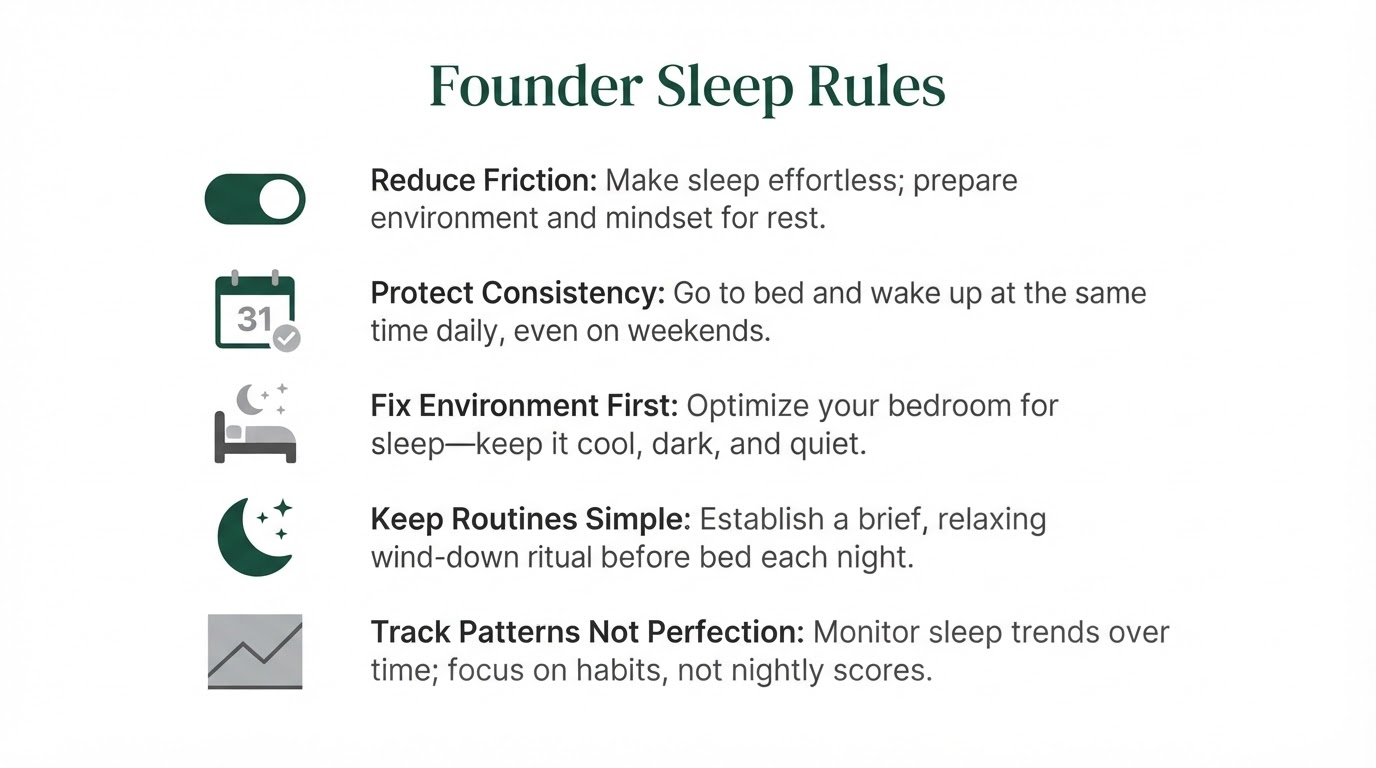
Consistent sleep and wake times are one of the most consistently supported sleep habits. Recent evidence and consensus guidance tie regular sleep timing to better sleep, better alertness, and stronger daytime functioning. A helpful way to say it is this: regular sleep timing is associated with better sleep and daytime performance, not guaranteed to fix every sleep problem.
That matters because irregular sleep does not just make you tired. It can make your mornings less predictable, your focus less stable, and late-day decisions harder than they need to be.
What Helps
- Choose a bedtime and wake time that fit your real life, not your fantasy week
- Keep your wake time as steady as possible
- If your schedule is off, shift it gradually
- Prioritize consistency over random catch-up sleep-ins
The Tradeoff
A fixed schedule can feel restrictive, especially if evenings are your only quiet work window. If your season includes travel, fundraising, or global time zones, aim for more consistency, not perfection. A schedule that holds most of the time is far more useful than an ideal routine that collapses every three days.
Build a Short Routine You Can Actually Keep
Once your schedule is steady enough, give your brain a clear signal that recovery starts now.
A useful sleep routine does not need to be elaborate. In fact, founder routines usually work better when they are short, familiar, and easy to keep even after a messy day. A good minimum version might look like this:
- Write tomorrow's top priorities
- Wash up
- Dim the lights
- Read a few pages of a physical book
- Go to bed
An ideal version might add a shower, light stretching, or slow breathing. But the key is repeatability, not complexity. Many founders get this wrong by building a routine that looks impressive but dies the first time a launch runs late, a kid wakes up, or a flight gets delayed. Consistency beats complexity here.
Cut Caffeine Earlier Than You Think
Caffeine clearly can worsen sleep, but the size of the effect depends on dose, timing, and your individual sensitivity. Current evidence suggests the closer caffeine gets to bedtime, and the larger the dose, the more likely it is to delay sleep or reduce sleep quality. A cautious takeaway is that many people benefit from avoiding caffeine in the late afternoon or evening, especially if they already sleep lightly.
That is more useful than pretending there is one universal cutoff for everyone.
A Practical Founder Rule
- Set a caffeine cutoff in the early afternoon
- Keep it consistent for a week
- If sleep is still friction-heavy, move the cutoff earlier
The tradeoff is simple: late-day work may feel harder at first. That usually means your system was leaning on stimulation, not real energy.
Reduce Screens and Activating Inputs Before Bed
Screens are not just a light problem. They are an activation problem.
Current evidence supports reducing screen use and mentally stimulating activity before bed, even if the strength of evidence varies by person and context. Bedtime device use is linked with worse sleep in many adult studies, and mainstream sleep guidance consistently recommends avoiding electronics close to bedtime and keeping the bed for sleep rather than work. The safest phrasing is that screen exposure and psychological stimulation may interfere with falling asleep and sleep quality, especially when used close to bedtime.
For founders, that often means:
- Stop work screens at least an hour before bed when possible
- Avoid one last check of inboxes, analytics, or Slack
- Put your phone out of reach
- Do not turn passive scrolling into fake decompression
If you are in a true crunch period, do not force an all-or-nothing rule. Tighten the boundary instead: finish the critical work, then cut the noise.
Be Careful With Late, Heavy Meals
The evidence here is less uniform than with sleep timing or caffeine, but reputable guidance still commonly recommends avoiding heavy meals close to bedtime. Large, rich, spicy, or very late meals can contribute to poorer sleep for some people, especially if they create reflux, discomfort, or excess heat.
A practical version:
- Eat dinner earlier when possible
- Keep evening meals moderate
- Go lighter on especially heavy or greasy foods near bedtime
- Do not turn late-night hunger into a delivery binge
If your schedule forces later dinners, focus on portion size and food choice first. You do not need perfect meal timing to improve sleep.
Make Your Bedroom More Sleep-Friendly
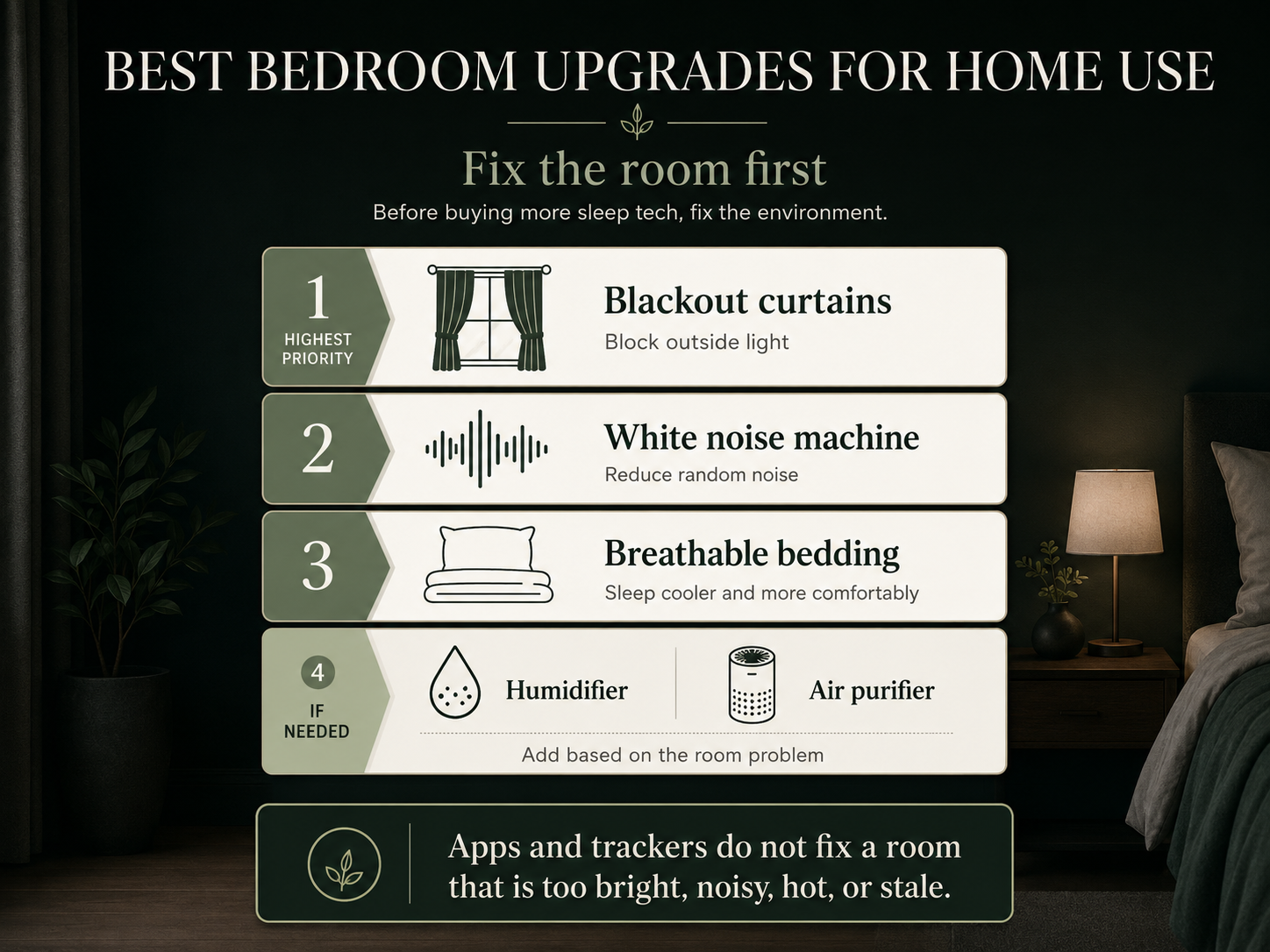
The most consistently recommended bedroom conditions are simple: dark, quiet, cool.
That is the highest-return place to start. For founders, the bigger issue is often that the bedroom still feels like a second office. Laptop on the nightstand. Notes for tomorrow in view. Notifications lighting up the room.
Practical Fixes
- Make the room darker with blackout curtains or a sleep mask
- Cut noise with white noise, a fan, or earplugs if needed
- Keep the room slightly cool
- Remove visible work clutter
- Upgrade obvious comfort problems if your mattress or pillow is working against you
You do not need a luxury sleep setup. You need a room that stops extending the workday.
When to Talk to a Doctor About Sleep
Sometimes cleaner habits are not enough. Reputable medical sources suggest seeing a doctor when sleep problems persist, especially if they affect daytime function. It is also worth getting evaluated sooner if you have loud snoring, gasping, unusual daytime sleepiness, leg restlessness, or a meaningful change in sleep that does not seem to improve.
This is especially relevant if you are:
- Lying awake or waking through the night for weeks
- Exhausted despite spending enough time in bed
- Waking with headaches, a racing heart, or major sleep disruption
- Relying harder and harder on caffeine to function
The cleanest way to say it is this: if sleep problems are ongoing and are affecting work, mood, recovery, or daily life, it is worth getting checked rather than guessing for months.
Final Thoughts
If you are an entrepreneur, poor sleep is often less about sleep itself and more about what your day failed to close. That is the real leverage point.
You probably do not need a more complicated nighttime routine. You need:
- A cleaner shutdown
- Fewer open loops at night
- More consistent sleep timing
- Less stimulation late in the day
- A bedroom that supports recovery
- The humility to get help if the basics are not enough
Better sleep is not a soft goal. It is operating leverage. For founders, it supports steadier decision-making, more emotional control under pressure, more reliable energy, and a pace you can actually sustain.
Is stress disrupting your sleep?
If your sleep is being disrupted by overwork or a workday that never fully shuts down, it helps to understand the difference between a rough stretch and a deeper capacity problem. Explore the Sleep Hub for practical recovery guides built for founders.
Note: This article is for educational purposes and is not medical advice. If sleep problems are persistent, worsening, or affecting daily functioning, talk to a qualified healthcare professional. Read our full Medical Disclaimer.