Best Stress Relief Tools for Entrepreneurs
A practical guide to matching the right tool to the actual source of stress — from acute overload and interruptions to workload, recovery, and founder isolation.
Entrepreneur stress is often treated like a regulation problem. Breathe better. Meditate more. Buy a gadget. Download an app.
Sometimes those tools help. But if your real problem is too much work, constant interruptions, unclear priorities, poor recovery, or nonstop availability, a calming tool is not going to fix the source.
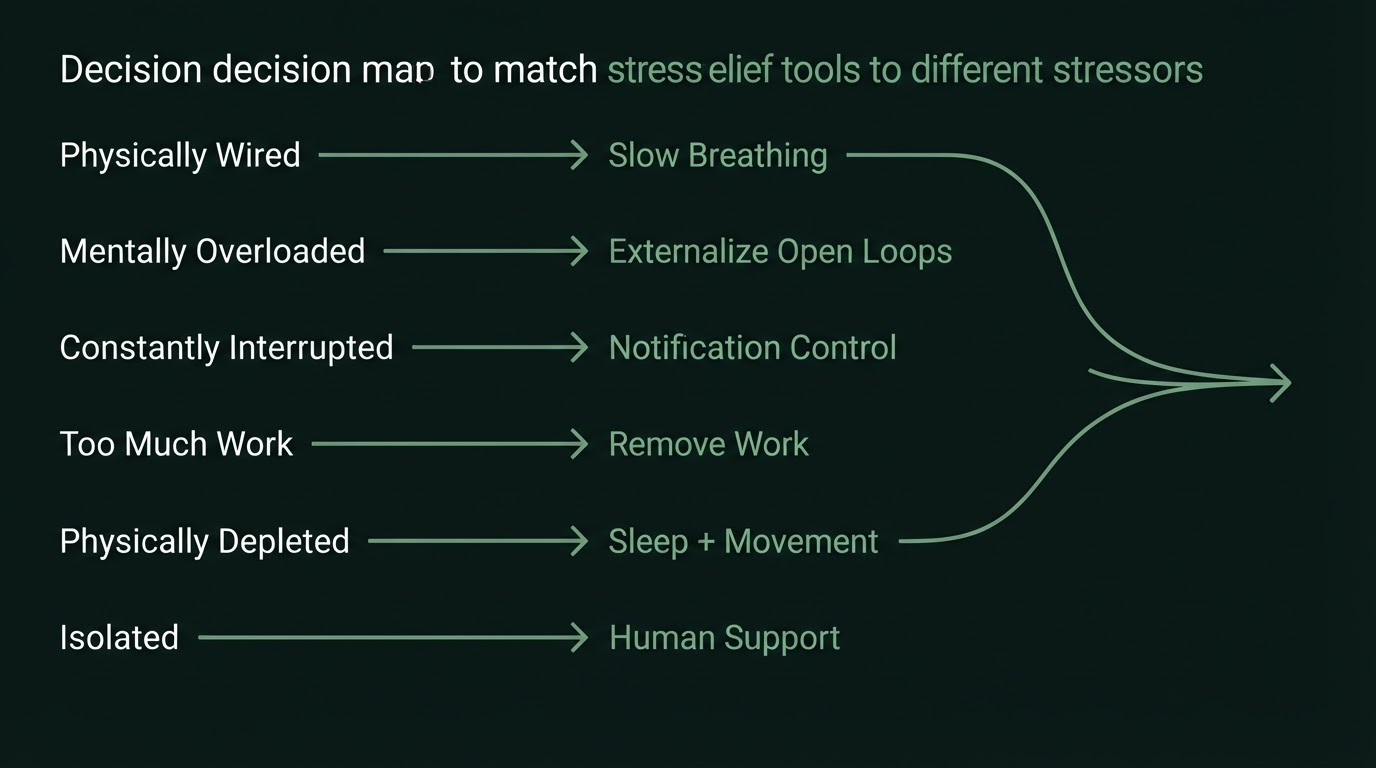
That is why the best stress-relief tool depends on the stressor.
Do not use a calming tool to compensate for a workload problem.
The Short Answer
If you want the fast version:
Match the intervention to the friction.
Start With the Stressor, Not the Tool
There are two broad categories of stress intervention. Both matter. But they solve different problems.
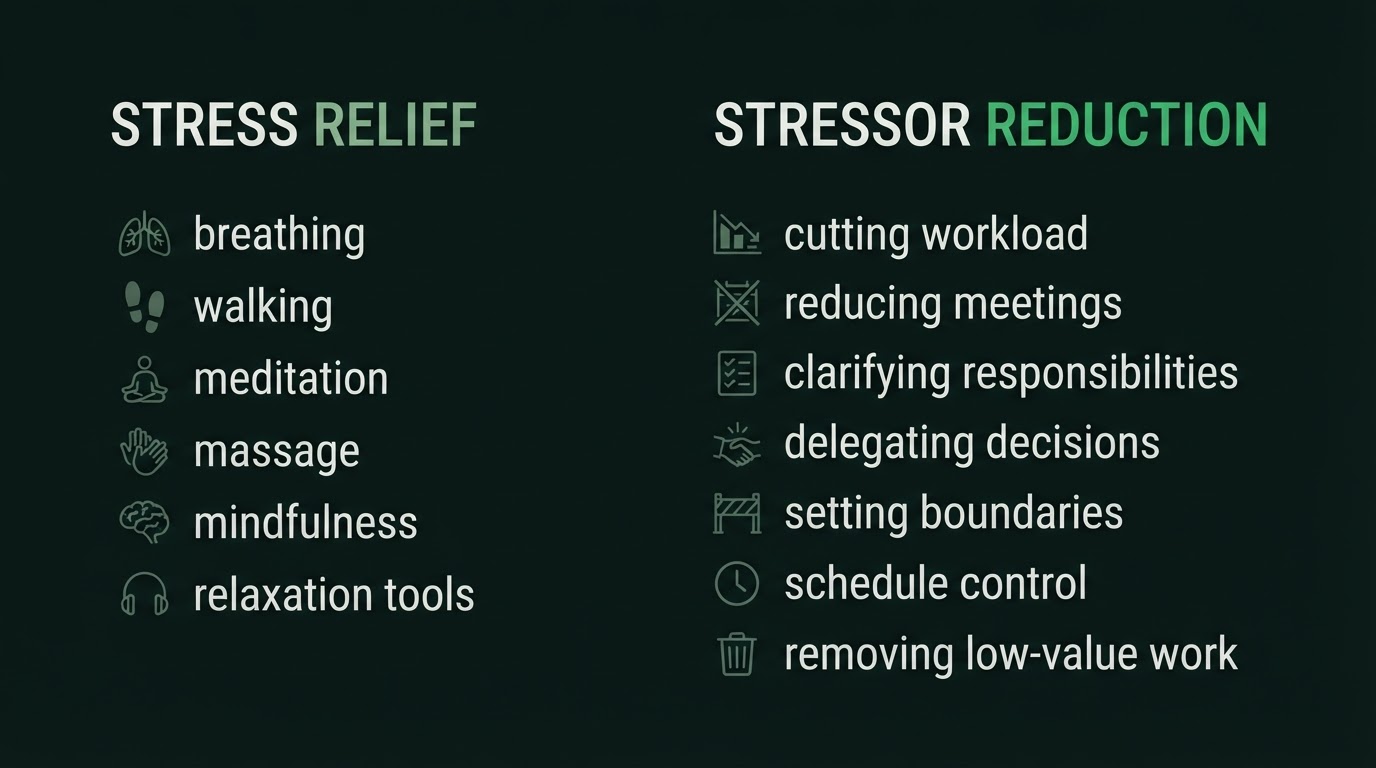
Stress Relief
Reduces the immediate stress response
- Breathing
- Walking
- Meditation
- Massage
- Mindfulness
- Relaxation tools
Stressor Reduction
Reduces the conditions producing the stress
- Cutting workload
- Reducing meetings
- Clarifying responsibilities
- Delegating decisions
- Setting communication boundaries
- Increasing schedule control
- Removing low-value work
A breathing exercise might help before a difficult client call. It does not fix an understaffed company.
A meditation app might help you downshift. It does not fix a calendar with nine hours of meetings.
A walk might reset your head. It does not solve a business where every operational decision still routes through you.
That is why the first question should be: What kind of stress am I trying to reduce?
Best Tool for Acute Stress: Slow Breathing
If you are physically activated before a negotiation, a difficult conversation, a high-stakes decision, sleep, or a stressful meeting, slow breathing is one of the simplest evidence-supported tools available.
A practical approach:
- Breathe around 4.5–6 breaths per minute
- Keep the inhale gentle
- Make the exhale slightly longer
- Continue for 5–10 minutes
For example:
Inhale 4 seconds. Exhale 6 seconds.
The goal is not to force enormous breaths. Keep it comfortable. If you feel dizzy, tingly, panicky, or uncomfortable, stop forcing the pattern and return to normal breathing.
Slow breathing can increase heart-rate variability during the exercise and may reduce perceived stress.
What it does not do:
- Fix chronic overload
- Cure anxiety
- Repair sleep deprivation
- Eliminate the stressor
Use it as a downshift tool, not a life strategy.
Best Tool for Mental Overload: Externalize the Open Loops
When your head feels full, the problem may not be emotional stress. It may simply be too many unfinished demands being held in working memory.
Open loops can include:
- Proposals
- Hiring decisions
- Client issues
- Invoices
- Personal errands
- Unfinished conversations
- Ideas
- Follow-ups
- Unresolved projects
Your brain is bad at peacefully ignoring unfinished work. A better strategy is to get it out of your head.
Use one trusted capture system. It can be:
- Paper
- Apple Notes
- Notion
- Todoist
- Asana
- Your calendar
- Another task system
The tool matters less than the behavior. For every active item:
- Capture it
- Define the next physical action
- Decide when or where you will handle it
- Delegate, defer, do, or deliberately drop it
Weak
"Fix website."
Better
"Tuesday at 10:00 AM: review homepage CTA and send edits to designer."
Specific plans reduce the need to keep mentally rehearsing unfinished work.
Best Tool for Cognitive Reset: Walking
Walking is underrated because it is too simple to sell as a sophisticated performance system. That is exactly why it works well for founders.
A 10–20 minute walk can create:
- Physical separation from the desk
- A break from near-focus work
- Lower stimulation
- A change in visual environment
- An opportunity to stop reacting
Useful moments:
- After a difficult call
- Between deep-work blocks
- Before an important decision
- After a long meeting stretch
- At the end of the workday
When possible, go outside. Nature exposure appears to provide additional short-term benefits for mood and perceived restoration in some studies.
You do not need a perfect nature dose. Go walk.
Best Tool for Guided Downshifting: Meditation
Mindfulness can modestly reduce perceived stress for some people. It is especially useful when you need help transitioning out of rumination, reactivity, mental acceleration, or nonstop task focus.
You do not need an hour-long practice. For acute use, 5–15 minutes may be enough to create a subjective reset. For a more durable experiment, try 10–20 minutes most days for 6–8 weeks and see whether it improves your ability to disengage.
Possible formats:
- Body scan
- Mindful breathing
- Mindful walking
- Guided meditation
The best modality is the one you will actually do.
What About Meditation Apps?
Apps such as Headspace, Calm, and similar platforms can help people practice consistently and appear to provide modest average improvements in perceived stress and well-being.
But there is no strong basis for saying one commercial app is universally superior. Choose based on usability, price, instructor voice, privacy, and whether you actually use it.
Do not confuse a subscription with treatment. An app is not a substitute for appropriate care for severe anxiety, depression, trauma, panic, substance misuse, suicidality, or significant insomnia.
Best Tool for Interruptions: Notification Control
Constant availability creates a form of stress that breathing exercises do not solve. Every Slack ping, email alert, text, app notification, and calendar interruption creates another opportunity to switch attention.
The research here suggests something useful: selective batching often makes more sense than total blackout.
Keep Always-On
- Actual emergency channel
- Critical family contacts
- Genuinely time-sensitive operational alerts
Batch
- Routine Slack
- Text messages
- Social notifications
- Low-priority app alerts
Process them perhaps 2–4 times per day instead of continuously. Use Focus or Do Not Disturb during high-value work. And tell your team what the emergency route is. That removes the anxiety that something critical might be missed.
Selective batching is usually more practical than total blackout.
Best Tool for Workload Stress: Remove Work
This is the most important category in the article.
If the stressor is too much work, the first-line intervention should be some version of eliminate, reduce, delegate, redesign, clarify, or renegotiate.
Not: "Become more resilient."
Occupational-health research consistently points toward workload, control, role clarity, staffing, and support as major levers.
Ask:
- Which meetings can disappear?
- Which reports do nobody use?
- Which decisions should another person own?
- Which customers or projects create disproportionate stress?
- Which responsibilities exist only because no one redesigned them?
- Which deadlines are artificial?
- Which commitments can be renegotiated?
This is stress management at the source.
What About Automation?
Automation can help. But it is not automatically stress relief. A workflow is useful only if it genuinely removes recurring work.
Good Automation
- Automatically routes qualified leads
- Syncs data between tools
- Sends routine confirmations
- Removes repetitive copying
- Reduces manual reporting
Bad Automation
- Requires constant troubleshooting
- Adds dashboards
- Creates exception handling
- Adds more alerts
- Increases monitoring
- Creates another tool everyone has to manage
The test is simple: did the automation remove work, or just move the work somewhere else?
That is where a tool like Zapier can be useful. Not because Zapier is a stress-relief product. Because removing repetitive administrative work can reduce unnecessary demand.
Best Tool for Overcommitment: Calendar Boundaries
Many founders do not have a stress-management problem. They have an availability problem. A calendar with no protected space guarantees that everything feels urgent.
Useful boundaries include:
- Meeting-free mornings
- Designated office hours
- Communication windows
- No-meeting days
- A hard shutdown time
- Travel buffers
- Protected thinking blocks
Stop every person, platform, and request from having equal access to your attention.
Best Tool for Physical Stress Recovery: Exercise
Movement is one of the strongest general-health tools available. For stress management, keep it simple.
Walking
Best for: low friction, cognitive resets, daily consistency
Aerobic Exercise
Useful for: general health, mood, sleep support, stress resilience
Resistance Training
Useful for: strength, physical health, long-term capacity
Yoga
May help when you want: movement, breathing, mobility, relaxation together
You do not need to optimize all of them. For many busy founders, a simple base is enough: walk most days, perform a couple of brief strength sessions weekly, add other activity you enjoy.
Exercise supports recovery. It does not fix an impossible workload.
Best Tool for Founder Isolation: Human Support
Some stress gets worse because there is nowhere safe to put it. Founders may not feel comfortable discussing financial pressure, fear, hiring mistakes, business uncertainty, leadership doubts, relationship strain, or exhaustion with employees.
Different support channels serve different purposes.
Trusted Peer or Founder Group
Useful for: perspective, normalization, practical advice, isolation
Mentor
Useful for: experience, decision context, pattern recognition
Coach
Potentially useful for: priorities, accountability, delegation, role clarity
Therapist or Licensed Mental-Health Professional
Appropriate when stress overlaps with: persistent anxiety, depression, panic, trauma, severe insomnia, substance misuse, inability to function normally
Human support reduces the amount of complexity one person is trying to hold alone.
What About Stress Gadgets?
This is where marketing tends to get ahead of evidence.
HRV Biofeedback
Verdict: Most defensible gadget-adjacent category
Useful for: Paced breathing feedback, skill practice
Caution: The sensor is not magic.
HRV Wearables
Verdict: Useful for trends and curiosity
Useful for: Trends, feedback, curiosity
Caution: Not for diagnosis or perfect daily stress scoring.
Weighted Blankets
Verdict: Potential comfort / sleep support
Useful for: Comfort for some users
Caution: Limited evidence for broad stress reduction.
Massage Devices
Verdict: Reasonable for relaxation
Useful for: Relaxation, muscle tension, comfort
Caution: Not a burnout treatment.
Vagus Nerve Wearables
Verdict: Interesting but optional / emerging
Useful for: Experimental consumer stress use
Caution: Do not make them a first-line intervention.
Acupressure Mats
Verdict: Fine if personally enjoyable
Useful for: Personal enjoyment
Caution: Weak evidence for unique stress benefit.
Fidget Devices
Verdict: Use if personally helpful
Useful for: Sitting, thinking, regulating
Caution: Do not overclaim clinical benefit.
Tools I Would Not Add First
When a founder tells me they are stressed, these are rarely my first recommendations:
- Another productivity app
- Another wearable dashboard
- An elaborate supplement stack
- Expensive stress gadgets
- A complicated morning routine
- Six different meditation practices
- More quantified-self tracking
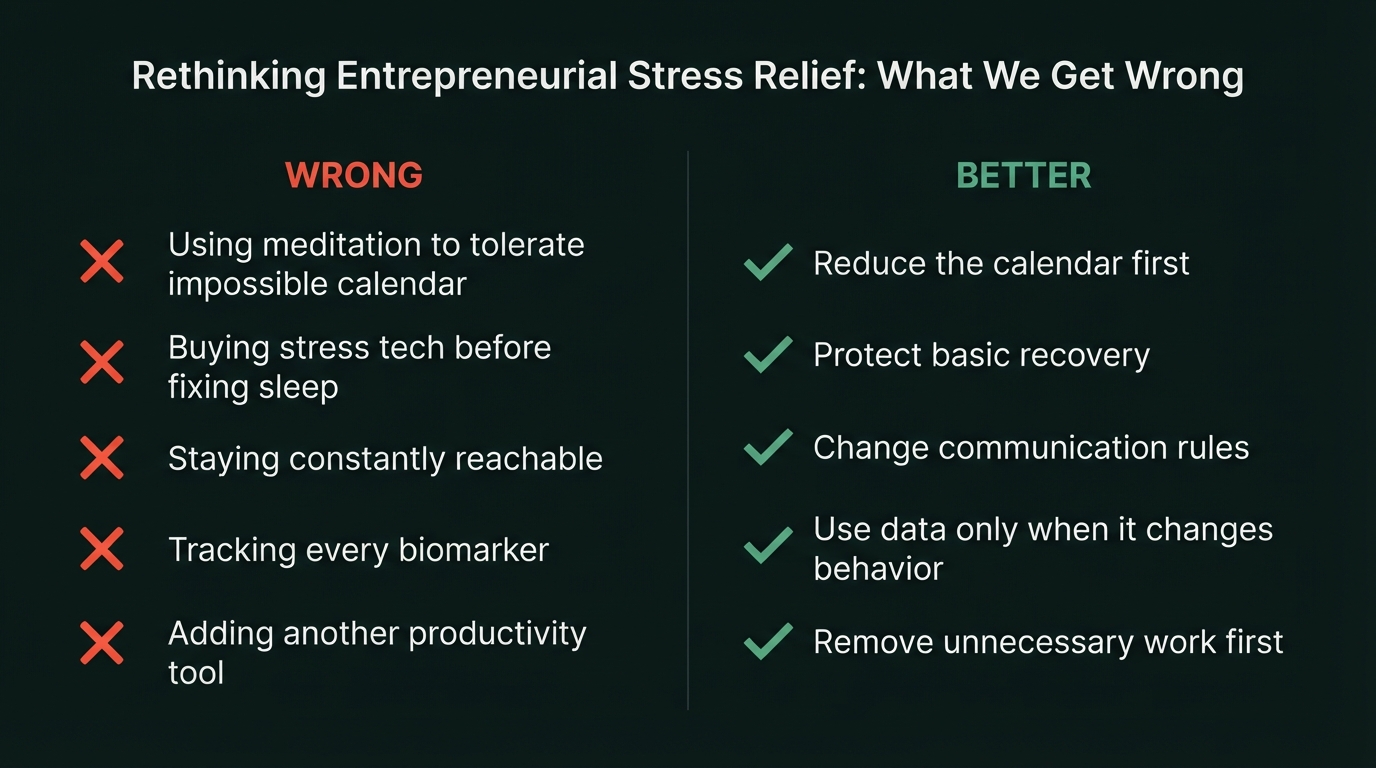
Why? Because every new tool has a maintenance cost. It adds another login, another decision, another habit, another dashboard, another thing to optimize.
Stress relief should reduce friction. Not become another project.
What Founders Usually Get Wrong
Build a Minimum Viable Stress System
You do not need a giant wellness stack. Start with four components.
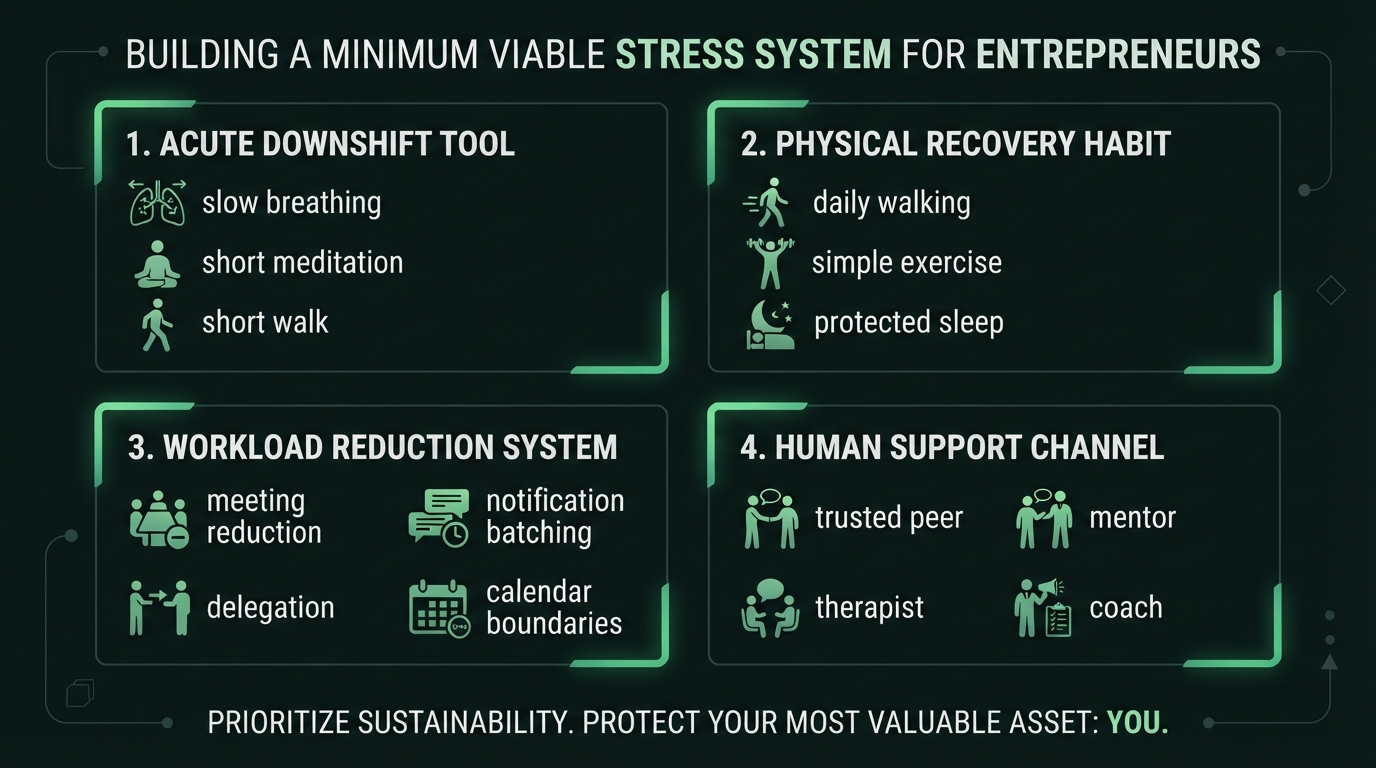
1. One Acute Downshift Tool
Choose one:
- Slow breathing
- Short meditation
- Short walk
2. One Physical Recovery Habit
Choose one:
- Daily walking
- Simple exercise
- Protected sleep routine
3. One Workload Reduction System
Choose one:
- Meeting reduction
- Notification batching
- Delegation
- Automation
- Calendar boundaries
- Elimination of low-value work
4. One Human Support Channel
Choose one:
- Trusted peer
- Mentor
- Therapist
- Partner
- Structured founder group
- Appropriate coach
That is enough to start. Use what works. Remove what does not.
When Stress Is More Than a Productivity Problem
Self-help tools have limits. Seek professional support when stress is:
- Persistent
- Worsening
- Interfering with basic functioning
- Causing severe sleep problems
- Associated with panic
- Driving increasing alcohol or substance use
- Overlapping with significant depression
- Affecting relationships or daily life broadly
If you are having thoughts of suicide or self-harm, seek emergency or crisis support immediately.
You do not need a better breathing app for a problem that requires clinical care. For a deeper look at when overload becomes something more, read Founder Burnout Symptoms or How to Recover From Founder Burnout Without Disappearing.
Founder Verdict
The best stress-relief tools for entrepreneurs are not necessarily the most sophisticated ones. For most founders, the categories rank like this:
Gadgets can be useful. Apps can be useful. Automation can be useful. But the hierarchy matters.
Stress relief reduces the response. Stressor reduction changes the conditions causing it.
Do both when necessary. Do not confuse one for the other.
FAQ
Feeling more than stressed?
Read our guide to recognizing the difference between a rough stretch and a deeper capacity problem.
Note: This article is for educational purposes and is not medical or mental-health advice. If symptoms are persistent, severe, or affecting daily functioning, talk to a qualified healthcare professional. If you are in crisis or having thoughts of self-harm, seek emergency help immediately.