
How to Recover From Founder Burnout Without Disappearing
A practical recovery plan for founders who cannot fully step away from the business but know the current operating system is no longer sustainable.
"Take a month off."
That advice sounds great when you are not the one running the company.
For many founders, completely disappearing is not realistic. Payroll still exists. Clients still need answers. Employees still need direction. Deals do not pause because your nervous system is cooked.
But the opposite approach is not sustainable either: keep working exactly the same way and hope a few workouts, better supplements, or a weekend away will fix it. They probably will not.
Burnout recovery starts when something about the load changes.
You may not need to disappear from the business. But you cannot recover while operating exactly the way that burned you out.
The Short Answer
If you think you are burning out, start here:
- Stop adding new commitments
- Identify the work that truly requires founder attention
- Reduce your availability
- Shrink the business temporarily to a minimum viable operating mode
- Protect sleep and basic physical recovery
- Delegate decisions with clear ownership
- Get support before functioning deteriorates further
- Seek professional evaluation when symptoms are severe, persistent, or extend beyond work
The goal is not to push through more efficiently. It is to lower chronic demand enough for recovery to start.
First: Make Sure This Is Actually Burnout
Burnout is commonly used to describe almost any form of exhaustion. That is too broad.
The World Health Organization describes occupational burnout as a work-related phenomenon involving three broad dimensions:
- Exhaustion
- Increased mental distance, negativity, or cynicism toward work
- Reduced professional efficacy
That work connection matters. Fatigue alone does not prove burnout.
Symptoms such as poor concentration, irritability, low motivation, headaches, sleep disturbance, low energy, and procrastination can appear during burnout, but they are not specific to it. They can also occur with:
- Depression
- Anxiety
- Insomnia
- Sleep apnea
- Anemia
- Thyroid problems
- Medication effects
- Chronic pain
- Substance use
- Other medical conditions
A useful question is: does the problem mainly intensify around work, and does it improve when you are genuinely away from work?
If exhaustion, low mood, loss of interest, poor functioning, or sleep problems are affecting every part of life rather than mainly work, do not assume it is "just burnout."
Founder Burnout Is Not Inevitable
Entrepreneurship is demanding, but founders are not automatically more burned out than employees. Some research has found entrepreneurs reporting lower burnout and greater engagement than employees, potentially because autonomy, meaning, and control can be protective.
The problem is what happens when those advantages disappear. Founder burnout risk rises when work starts to look like:
- High role overload
- Constant emotional demands
- Financial pressure
- Low recovery
- Too little practical control
- Weak support
- Inability to disengage
- Compulsive work involvement
The problem is not simply that founders work hard. It is when work becomes compulsive and recovery becomes impossible.
Why "Just Take a Vacation" Often Fails
Time away can help. Vacations, weekends, breaks, and sabbaticals can improve well-being and reduce exhaustion temporarily.
But there is a catch: the benefit often fades when the person returns to the same workload and work design.
Time Off Can Help
- Reduce exhaustion temporarily
- Create distance
- Restore perspective
Effect Fades If You Return To
- 14-hour days
- Constant Slack
- Every decision routed through you
- Impossible deadlines
- No calendar control
- Weak boundaries
Recover while changing what you are returning to.
Step 1: Stop Adding Load
The first move is not optimization. It is containment. If you are already overloaded, stop increasing the load.
For the next one to two weeks:
- Pause optional projects
- Decline nonessential meetings
- Delay experiments that can wait
- Stop volunteering for new commitments
- Pause unnecessary travel
- Reduce low-value networking
- Postpone projects that do not protect revenue, customers, staff, or critical operations
Ask: What happens if this does not get done this week?
If the answer is "not much," it probably should not stay on your recovery-week calendar.
Recovery starts with containment, not optimization.
Step 2: Identify What Actually Requires Founder Attention
Burned-out founders often make the problem worse by holding too many roles. You might still be acting as salesperson, account manager, project manager, recruiter, approver, customer-support escalation, strategist, finance reviewer, content editor, and operations manager.
That may have been necessary at an earlier stage. It does not mean it still is. Create three buckets:
Founder-Only
Decisions that genuinely require your judgment.
- Major hiring decisions
- Cash or capital allocation
- Strategic direction
- High-risk legal or partnership decisions
- Critical customer relationships
Someone Else Should Own This
Work where another person has enough information and ability to decide.
This Should Disappear
Meetings, reports, approvals, and habits that exist because nobody has questioned them.
Too many decisions remain founder decisions long after they should.
Step 3: Reduce Your Availability
Being reachable all day is not the same as being a good founder. Continuous availability increases interruption, emotional switching, decision load, recovery failure, and the feeling that work never ends.
During recovery, create explicit communication windows. For example:
Your team needs to know:
- What counts as urgent
- What can wait
- Who owns what
- When you will respond
- What no longer requires your approval
Reducing availability is not abandonment. It is a temporary control system.
Step 4: Create a Minimum Viable Workweek
If completely stepping away is unrealistic, temporarily operate the business at the minimum level required to remain healthy and functional. Think of it as a minimum viable workweek.
What is the smallest amount of founder work required to keep the business stable while recovery begins?
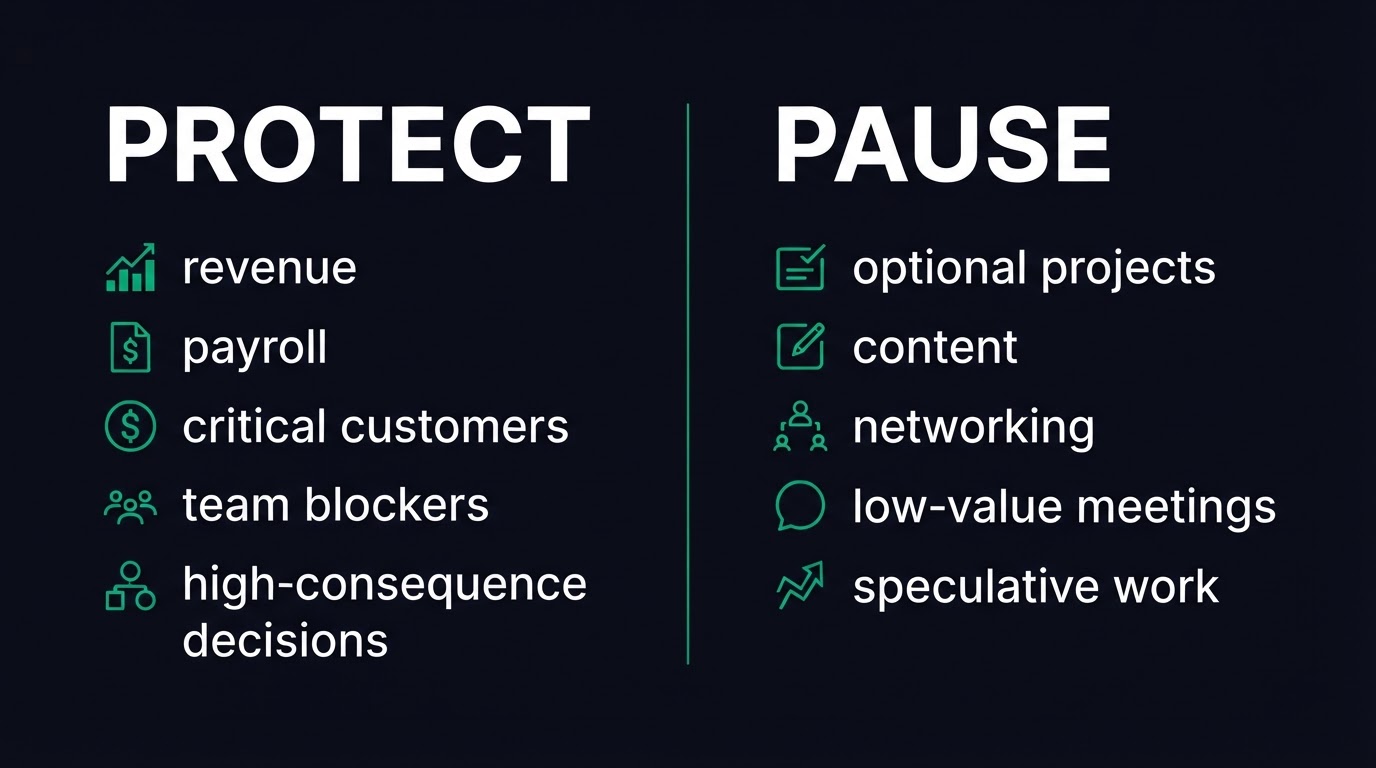
Prioritize
- Critical revenue
- Payroll / cash
- Major customers
- Real team blockers
- High-consequence decisions
- Urgent legal / operational issues
Temporarily Reduce
- Content
- Networking
- Optional strategy
- Unnecessary reporting
- Low-value meetings
- Speculative projects
Define working windows rather than leaving the day open-ended. For example:
Cap the work instead of allowing work to expand into every available hour.
Step 5: Protect Sleep, Food, Movement, and Recovery
These things matter. They are just not replacements for workload reduction.
Sleep
Poor sleep and burnout can reinforce each other. Protect:
- A consistent wake time
- Sufficient sleep opportunity
- Reduced late-night work
- A real transition between work and bed
- Evaluation for persistent insomnia or possible sleep disorders
Do not try to recover from burnout while repeatedly cutting sleep to rescue the company. For a deeper system, read How Entrepreneurs Can Sleep Better.
Food
Under high stress, founders often skip meals, under-eat, rely on caffeine, eat late, and make random convenience choices. Recovery is not the time for an elaborate diet. Use simple defaults:
- Reliable breakfast or first meal
- Easy protein
- Fruit / vegetables
- Accessible snacks
- Hydration
- Less dependence on caffeine as a replacement for sleep
Movement
Exercise can help mood, health, stress regulation, and possibly some dimensions of exhaustion. But it is not a burnout cure. You do not need to turn recovery into another performance goal.
- Walking counts
- A short strength session counts
- Easy cardio counts
These support recovery. They do not replace workload reduction.
Step 6: Delegate With Decision Rights
"Delegate more" is incomplete advice. Delegation without rules often creates more questions, more rework, more approvals, and more interruptions.
Instead, establish decision rights. For each area, define:
- Who owns it
- What they can approve
- Financial or risk thresholds
- What requires escalation
- What does not require your involvement
- How decisions should be documented
Instead of
"Ask me before approving vendor expenses."
Use
"You own vendor decisions under $2,000 if they are inside the approved budget. Escalate only if the contract exceeds six months or creates legal risk."
Delegation without authority creates more questions. Delegation with rules removes founder load.
Step 7: Add Support Before You Hit the Wall
Burnout becomes harder when everything stays inside your head. Different support solves different problems.
Therapist
Depression, anxiety, insomnia, perfectionism, work compulsion, identity issues.
Physician
Persistent physical symptoms, severe sleep problems, medical causes that need evaluation.
Peer / Cofounder / Leadership
Isolation, operational perspective, decision support.
Coach
Structure, accountability, business systems.
Coaching is not a substitute for medical or mental-health care.
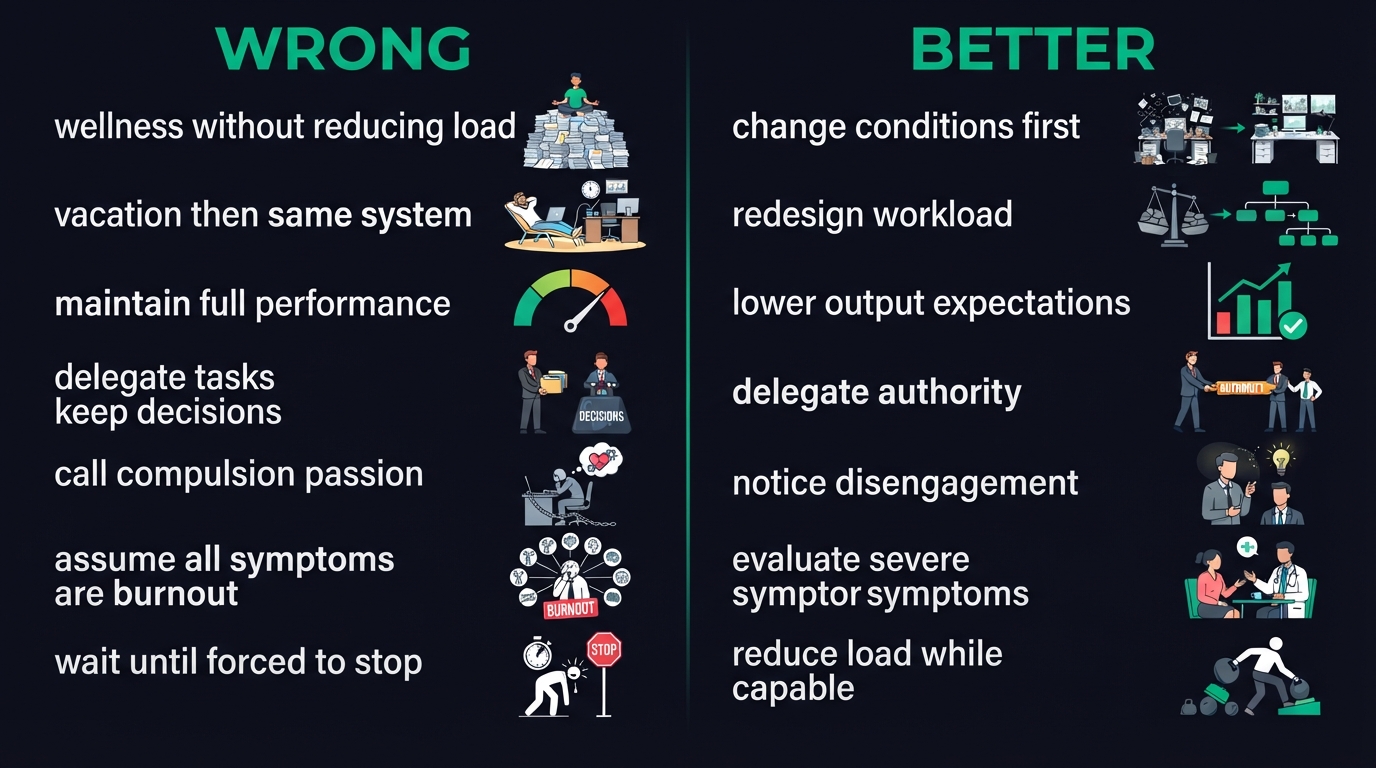
What Founders Usually Get Wrong
When You Actually Do Need to Step Away
"Recover without disappearing" is not always the right answer. There are situations where continuing to operate normally is unsafe or unrealistic.
Seek professional help promptly if you are experiencing:
- Persistent depression
- Hopelessness
- Severe anxiety or panic
- Major sleep disruption
- Increasing alcohol or substance use
- Inability to perform basic work or daily tasks
- Physical symptoms that could have a medical cause
- Major deterioration across work and personal life
If you are thinking about suicide or harming yourself, seek emergency help immediately.
Burnout language should never become a reason to ignore a serious mental-health or medical problem.
A 7-Day Founder Burnout Stabilization Plan
This is not a seven-day cure. It is a way to stop the situation from getting worse and create room for recovery.
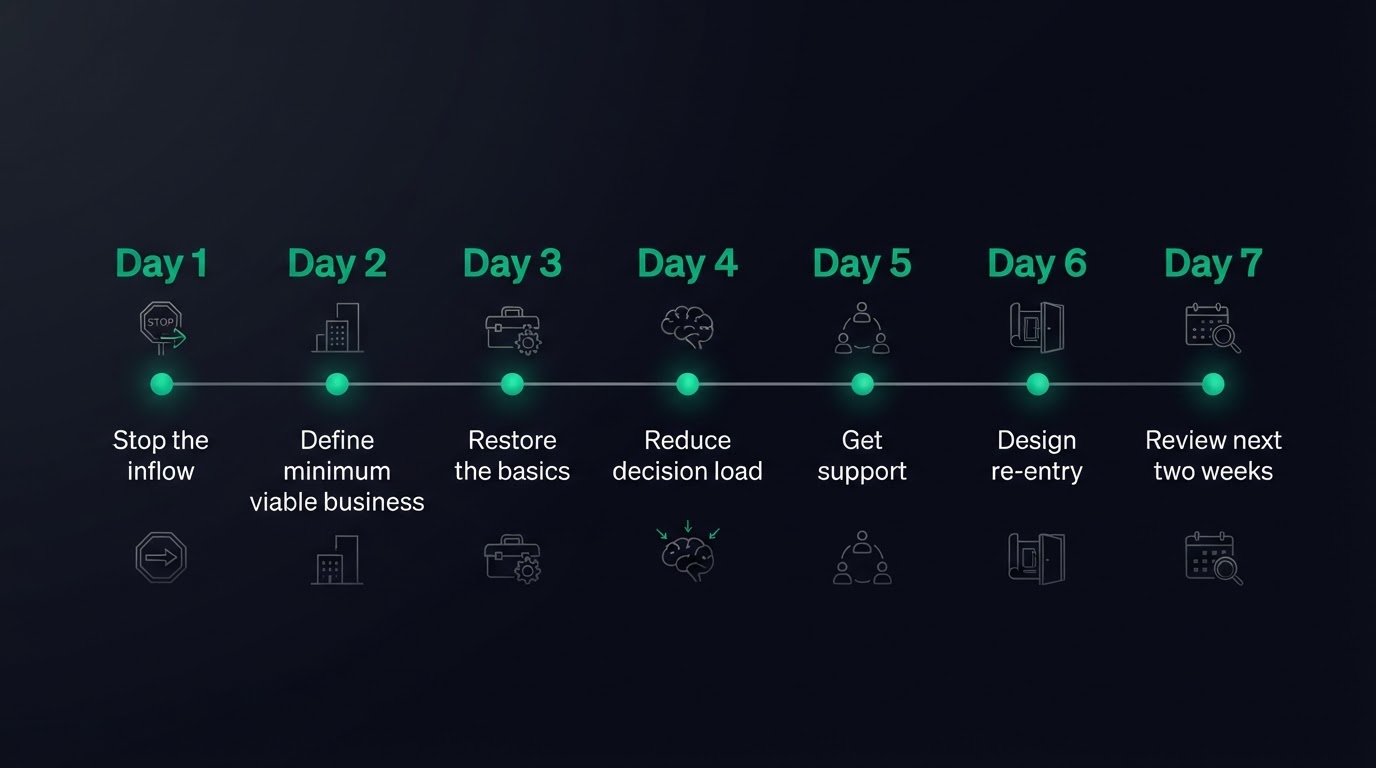
Day 1: Stop the inflow
- Cancel or delay nonessential meetings
- Pause new commitments
- Mute unnecessary notifications
- Identify what can wait
- Tell your team you are temporarily reducing availability
Day 2: Define the minimum viable business
- Critical customers
- Payroll / cash responsibilities
- Operational emergencies
- Key team decisions
- Obligations with real consequences
Day 3: Restore the basics
- Sleep opportunity
- Regular meals
- Hydration
- Outdoor light
- Easy movement
Day 4: Reduce decision and interruption load
- Communication windows
- Decision thresholds
- Delegated owners
- An escalation policy
Day 5: Get support
- Have one honest conversation with someone qualified or trustworthy
- Ask: what am I missing?
- Ask: what looks unsustainable from the outside?
- Ask: what needs professional help?
Day 6: Design re-entry
- What stays paused
- What stays delegated
- Which boundaries remain
- What work is permanently removed
Day 7: Review the next two weeks
- What created the most stress?
- What actually improved?
- What work can stay removed?
- What needs another owner?
- Do I need medical or mental-health support?
A Simple Daily Recovery Structure
During the first recovery phase:
- Wake at a consistent time
- Get light and food
- Identify the one genuinely important founder task
- Protect one concentrated block
- Keep communication closed if possible
- Eat
- Walk
- Process necessary communication
- Handle lower-cognitive-load work only if required
- Create a real shutdown
- Stop routine business communication
- Reduce stimulation
- Protect sleep
It is intentionally boring. That is the point.
What the Research Suggests Overall
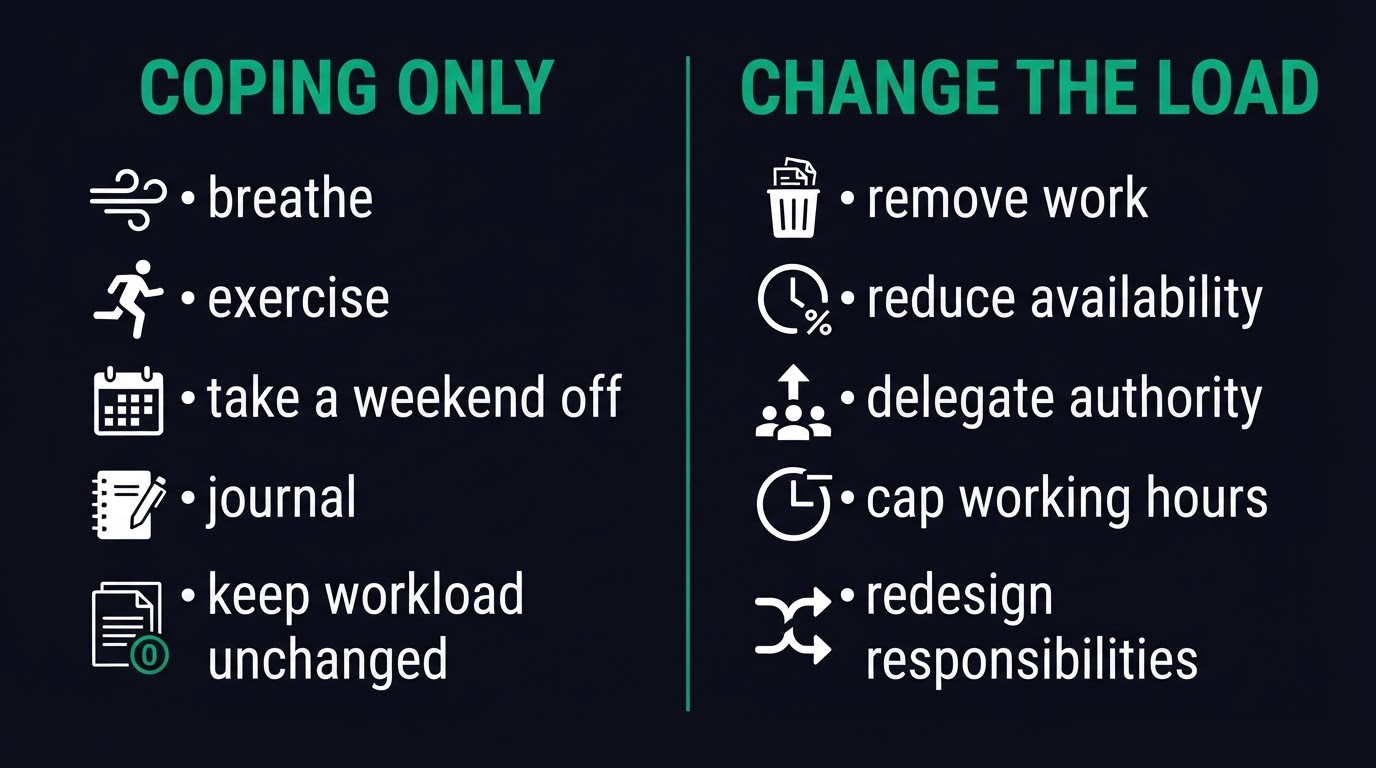
The strongest practical takeaway is not: become more resilient so you can tolerate the same workload. It is: change the demand-resource equation.
That may mean:
- Less work
- Fewer commitments
- More staffing
- Clearer roles
- Greater decision autonomy
- Fewer interruptions
- Stronger support
- Better recovery
- Professional treatment when needed
Individual tools still matter. Mindfulness can help some people. Exercise can help. Therapy can help. Sleep matters enormously. But none of those should be used to justify leaving an unsustainable work design untouched.
Founder Takeaway
You do not necessarily have to shut down the company or disappear for a month to start recovering. But something has to change. Start with:
- Stop adding load
- Narrow your founder role
- Create a minimum viable workweek
- Reduce availability
- Delegate decision rights
- Protect sleep and basic physical recovery
- Get support
- Evaluate persistent or severe symptoms professionally
Recovery practices cannot indefinitely compensate for an operating system that keeps recreating the problem.
Do less. Protect what matters. Change what you return to.
FAQ
Not sure whether what you are feeling is burnout?
Read our guide to recognizing the difference between a rough stretch and a deeper capacity problem.
Note: This article is for educational purposes and is not medical advice. If symptoms are persistent, severe, or affecting daily functioning, talk to a qualified healthcare professional. If you are in crisis or having thoughts of self-harm, seek emergency help immediately.