
Do Blue Light Glasses Really Help?
What the evidence says about digital eye strain, sleep, clear lenses, amber lenses, and what actually helps heavy screen users.
Blue light glasses are everywhere. They are sold to people who stare at screens all day, work late into the evening, deal with tired eyes, get headaches, and want to protect their sleep.
The pitch sounds simple: screens emit blue light, blue light causes problems, filter the blue light and you solve the problem.
The evidence is much less convenient. For daytime digital eye strain, blue-light filtering glasses have not consistently outperformed ordinary clear lenses. For sleep, the question is different — strong amber or orange lenses that meaningfully reduce short-wavelength evening light may be useful under the right conditions.
So before buying a pair, ask a better question:
What problem are you actually trying to solve?
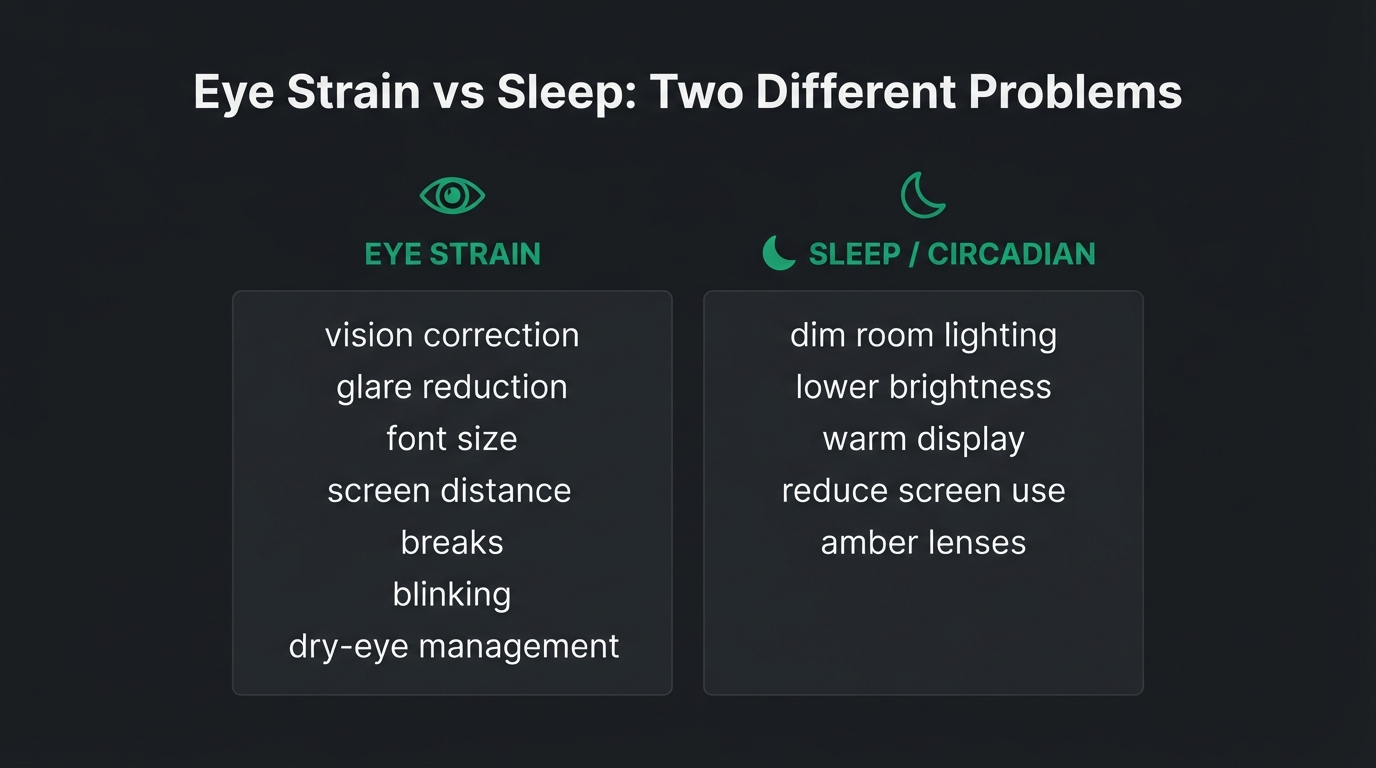
Daytime eye strain and nighttime circadian disruption are two different problems.
The Short Answer
If your problem is eye strain from working on screens all day, blue-light glasses would not be the first move.
If Your Problem Is Eye Strain
- Correct vision issues
- Reduce glare
- Increase text size
- Improve screen distance
- Take regular breaks
- Blink fully
- Treat dry-eye symptoms
If Your Problem Is Late-Night Light / Sleep
- Dim room lighting
- Lower screen brightness
- Use warm display settings
- Reduce stimulating screen use
- Use stronger amber/orange lenses if needed
Do not buy one product expecting it to solve two different problems.
What Blue Light Actually Does
Blue light is part of normal visible light. You get far more blue light from daylight than from a laptop or phone.
That does not mean light is irrelevant. Short-wavelength light — particularly in the blue-cyan range — plays an important role in circadian signaling. Exposure at the wrong time can affect melatonin and the timing of your internal clock.
But that is different from saying "the blue light from your monitor is damaging your eyes." Current human evidence does not establish normal consumer screen exposure as a cause of retinal damage or macular degeneration.
That distinction matters because a large part of the blue-light-glasses market is built on fear rather than useful decision-making.
Circadian light effects and eye damage are not the same claim.
Blue Light Glasses for Eye Strain: What the Evidence Shows
This is where the marketing runs into trouble. The strongest review evidence does not show a meaningful short-term advantage for blue-light filtering lenses compared with ordinary clear lenses for computer-related eye strain.
Studies have generally failed to show consistent improvements in:
- Visual fatigue
- Digital eye strain symptoms
- Visual acuity or contrast sensitivity
- Color discrimination
- Objective visual-performance measures
Evidence for headaches and dry-eye improvement is also weak or insufficient. That does not mean your eyes are imagining the discomfort. It means blue light probably is not the main reason your eyes feel bad after eight hours at a screen.
Your eyes can feel tired after a long screen day without blue light being the main cause.
Why Screens Still Make Your Eyes Feel Tired
Long screen sessions can absolutely leave your eyes feeling dry, gritty, blurry, heavy, irritated, tired, or difficult to refocus. But several more plausible contributors exist.
Reduced and incomplete blinking
When people concentrate on screens, blinking can become less frequent or less complete. That can destabilize the tear film and contribute to dryness and fluctuating vision.
Sustained near focus
Your visual system spends long periods working at a relatively fixed distance, which fatigues the focusing mechanism.
Poor display setup
Tiny text, poor contrast, bad monitor height, excessive glare, and awkward viewing distance all add friction.
Uncorrected vision issues
A prescription that is slightly wrong can become much more noticeable during hours of close work.
Dry-eye conditions
Air conditioning, contact lenses, low humidity, and existing dry eye can all make screen sessions worse.
That is why changing the color spectrum of your glasses often does not solve the underlying problem.
What Helps Digital Eye Strain More Reliably
There is no single universal cure for digital eye strain. The better approach is to identify what is creating the discomfort.
1. Fix your viewing setup
- Readable font size
- Comfortable screen distance
- Slightly downward viewing angle
- Reduced reflections and even ambient light
- Screen brightness that roughly matches the room
If you are leaning forward, squinting, or fighting reflections, fix the workstation before buying another accessory.
2. Break up continuous near work
The famous 20-20-20 rule is easy to remember, but its exact numbers are not strongly validated. That does not make breaks useless. It means you do not need to obsess over the formula. Use regular opportunities to look farther away, stand up, blink fully, and give sustained near focus a break.
3. Pay attention to blinking
A useful habit is several slow, complete blinks when finishing an email, changing tasks, or waiting for a page to load. Simple beats elaborate.
4. Address dryness
If your symptoms are mainly burning, grittiness, transient blur, or a dry sensation late in the day, dry-eye management may matter more than blue-light filtering. Persistent symptoms should be evaluated by an eye-care professional.
5. Get your prescription checked
If screen work causes persistent headaches, squinting, blurry text, difficulty refocusing, or double vision, make sure you are not trying to optimize around a basic vision problem.
Clear Blue-Light Glasses vs Amber Evening Glasses
This is one of the most important distinctions in the article. Not all "blue light glasses" do the same thing.
| Lens Type | Best Fit | Evidence |
|---|---|---|
| Clear Blue-Light | Daytime wear / comfort product | Weak for eye strain, limited for sleep |
| Amber / Orange | Evening circadian light reduction | More plausible for evening use, not a guaranteed sleep fix |
| Red | Very aggressive short-wavelength blocking | Strong color distortion, often unnecessary |
Dark lenses should not be used while driving at night, walking in unsafe low-light environments, performing safety-critical work, or doing tasks that depend on accurate color perception.
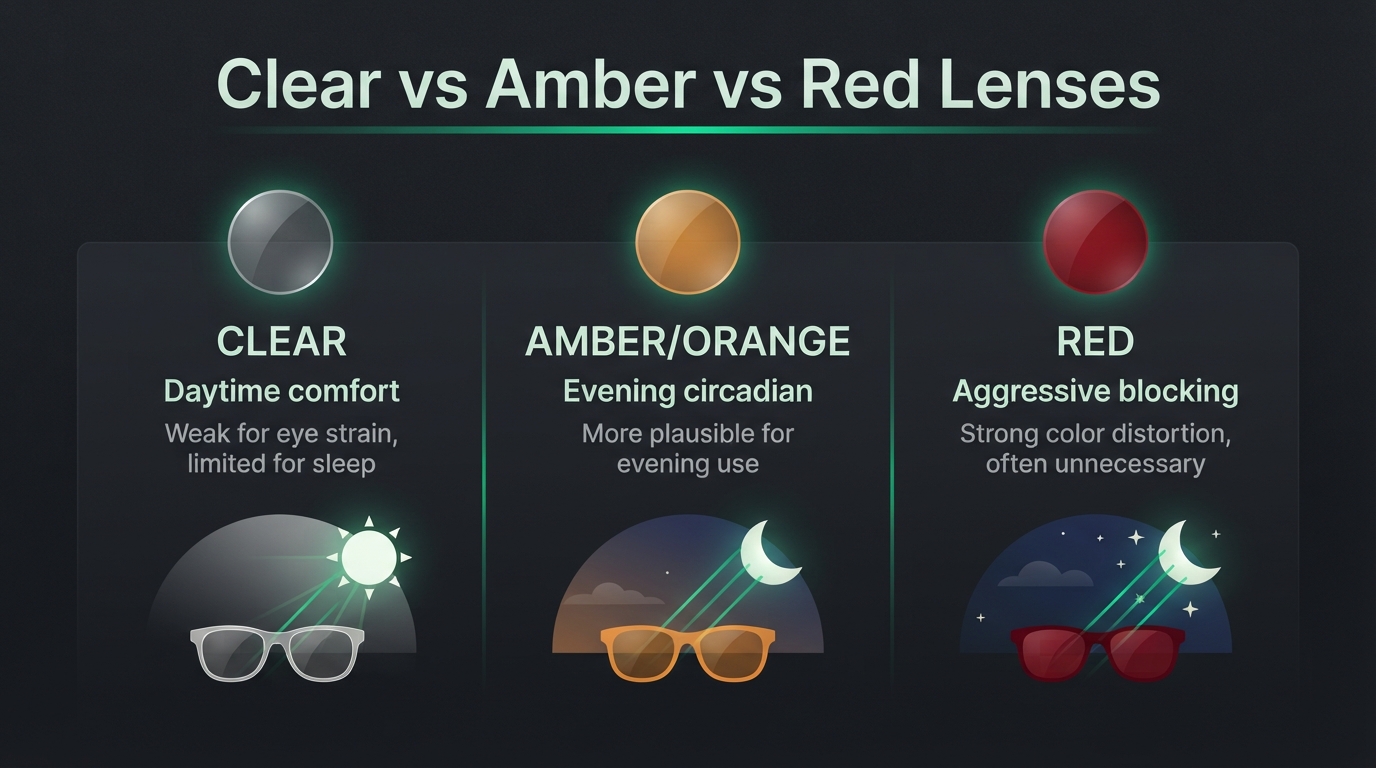
Different lenses solve different problems.
Blue Light Glasses for Sleep: A Different Question
This is where blue blockers become more interesting. Evening light can influence circadian timing and melatonin. But your eyes do not care whether that light comes from a laptop, a television, a phone, overhead LEDs, bathroom lighting, or kitchen lighting.
That is why focusing only on your screen can miss the larger problem. A dim phone in a dark, warm room is not the same exposure as a bright monitor under full overhead LEDs. Total evening light matters.
Your eyes do not care whether the light comes from a phone or the ceiling.
Stronger Blocking Matters More for Sleep
Clear coatings usually do not reduce enough of the circadian-relevant part of the spectrum to expect a large biological effect. The stronger sleep studies have generally used visibly tinted lenses that substantially reduce short-wavelength light.
That does not mean stronger glasses automatically improve sleep:
- Timing still matters
- Brightness still matters
- Duration still matters
- Individual sensitivity still matters
- What you are doing on the screen matters too
Answering an angry client email at midnight with orange glasses on is still answering an angry client email at midnight.
A Better Evening Light Strategy
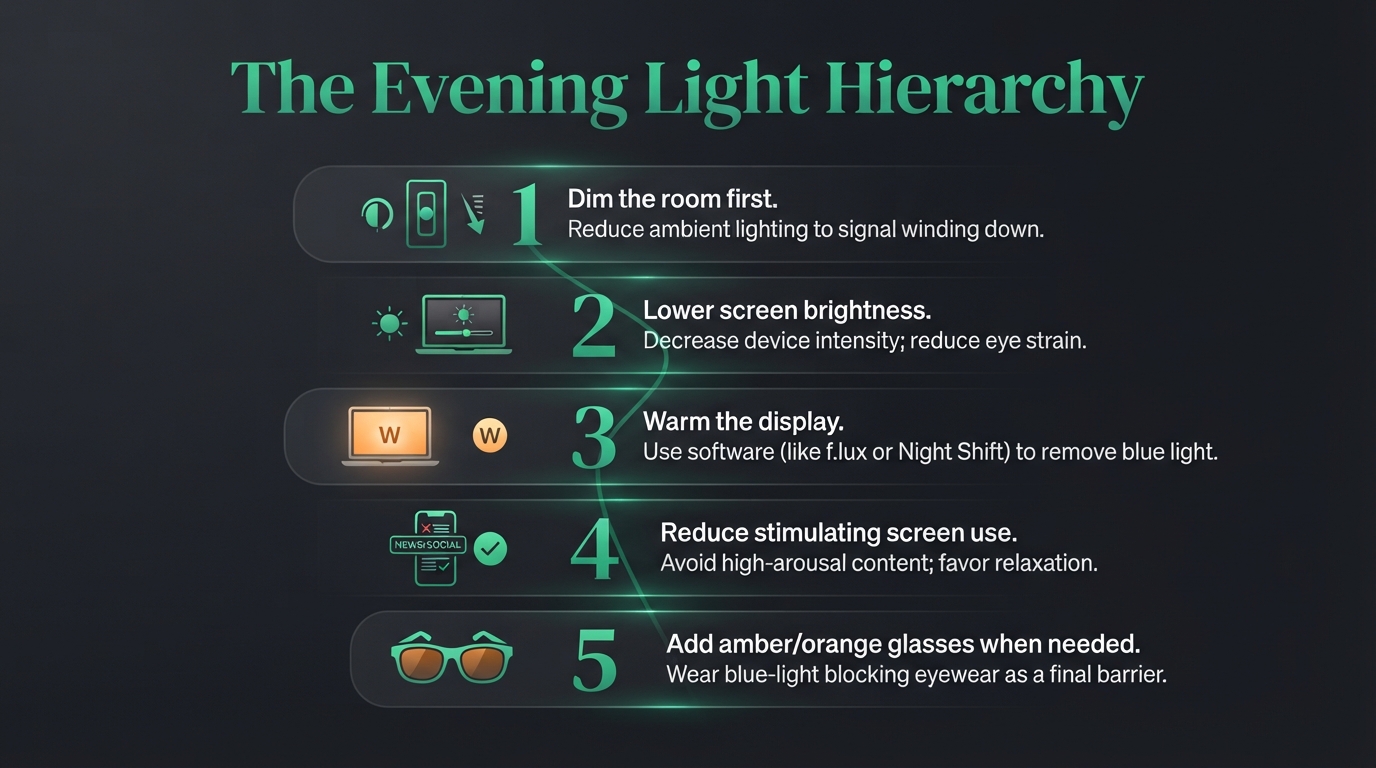
If sleep is the goal, use this hierarchy. Each step builds on the one before it.
- 1
Dim the room first
Turn off bright overhead lighting. Use warm, indirect lamps. This is the highest-leverage move.
- 2
Lower screen brightness
Do not run a bright display in a dark room. Lower brightness until it is comfortable.
- 3
Warm the display
Use Night Shift, f.lux, or similar warm-display settings. Low-friction and worth using.
- 4
Reduce stimulating screen use
Late-night work, Slack, email, social media, and gaming can delay sleep through attention and stress.
- 5
Add strong amber/orange glasses when needed
This is where blue blockers fit. They make the most sense when you cannot control the environment.
Who Might Actually Benefit?
Consider Strong Evening Blockers If:
- You work late regularly
- You cannot control room lighting
- Travel disrupts your environment
- You need bright screens close to bedtime
- You are intentionally reducing evening circadian light
Skip Clear Blue-Light Glasses If:
- You are buying them mainly for generic eye strain
- Your problem is dry eye
- Your workstation has glare issues
- Your prescription is outdated
- You expect retina protection from normal screens
What to Look for If You Buy a Pair
Ignore vague claims like "blocks 40% of blue light" or "digital protection." Those percentages often refer to different wavelength ranges and are difficult to compare.
- Visibly amber/orange tint for circadian use
- Published transmission spectrum if available
- Meaningful short-wavelength attenuation
- Comfort and fit you will actually wear
Do not pay a premium just because the lens is branded as "biohacking" technology.
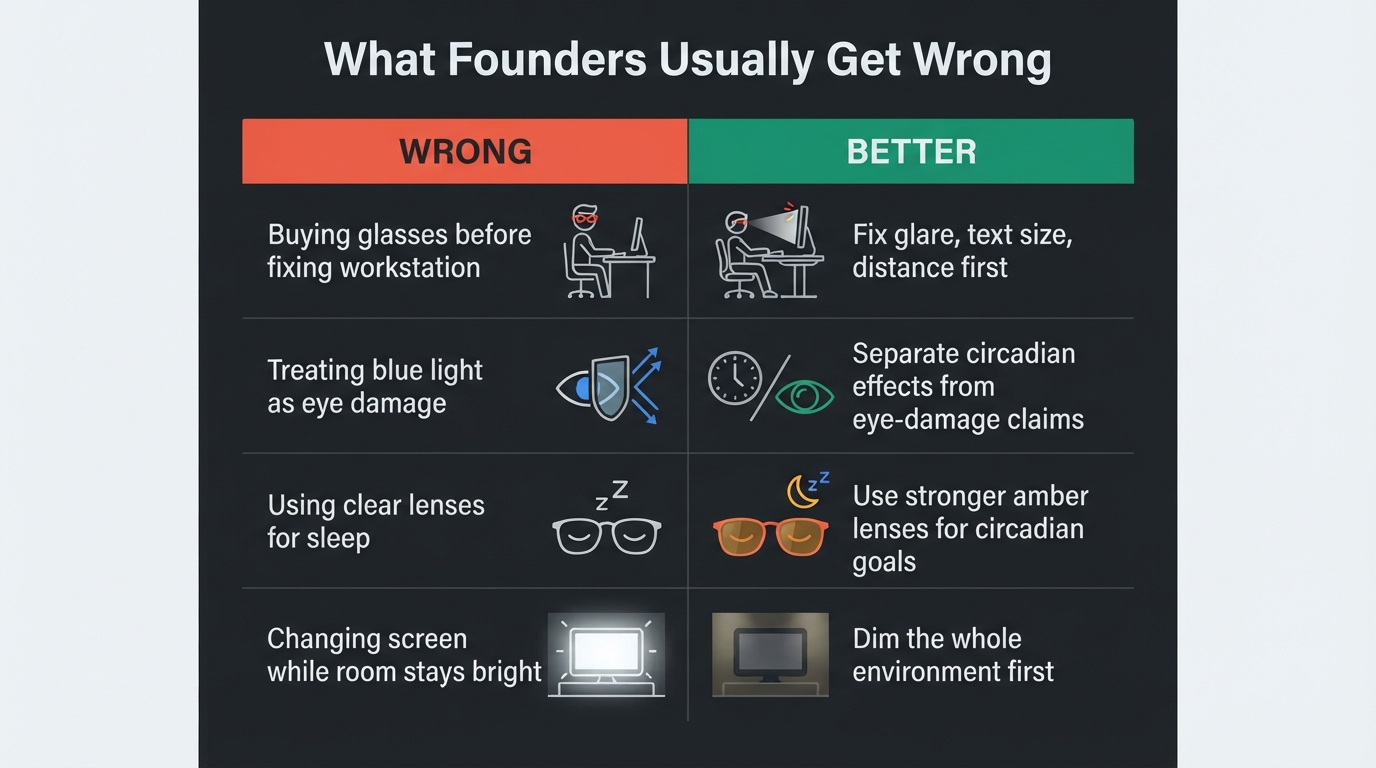
What Founders Usually Get Wrong
Wrong: Buying glasses before fixing the workstation
Better: Fix glare, text size, distance, lighting, dryness, and prescription first.
Wrong: Treating blue light as eye damage
Better: Separate normal consumer screen exposure from real phototoxic exposures.
Wrong: Using clear lenses for sleep
Better: If circadian control is the goal, stronger amber/orange lenses make more sense.
Wrong: Changing the screen while leaving the room bright
Better: Dim the whole environment first.
Wrong: Wearing blue blockers while continuing intense work until bed
Better: Manage both the light and the behavior.
Wrong: Turning evening light management into another optimization obsession
Better: Build a simple setup that survives a real workweek.
A Practical Founder Setup
If your target bedtime is 11:00 PM, here is a simple evening light timeline.
8:00–9:00 PM
Reduce household lighting
Use warm lamps instead of bright overhead lights. Keep the bedroom dark.
9:00 PM
Enable warm display mode
Turn on Night Shift or similar warm-display settings. Reduce screen brightness.
9:30–10:00 PM
Add amber/orange lenses if needed
If bright screens or room light remain unavoidable, put on strong amber/orange lenses.
Final 30–60 minutes
Move away from stimulation
Step away from email, work, social media, news, gaming, and emotionally activating content.
Morning
Get outdoor light
Morning light and regular wake timing help anchor the circadian system.
When Blue Light Glasses Are Probably Not the Real Fix
If Your Eyes Hurt Because:
- Prescription issue
- Dry eye
- Tiny text
- Glare
- Poor blinking
- No breaks
If Your Sleep Is Poor Because:
- Late work
- Late caffeine
- Alcohol
- Sleep apnea
- Chronic stress
- Inconsistent schedule
- Mental carryover
In either case, blue-light glasses are probably solving the wrong problem. If your sleep is breaking down because your workday never shuts off, read how entrepreneurs can sleep better next. If the deeper issue is chronic overload, start with founder burnout symptoms.
Match the intervention to the actual friction.
Founder Verdict
So, do blue light glasses really help?
For Daytime Digital Eye Strain
Probably not a first-line solution. Current evidence does not show a reliable advantage over ordinary clear lenses.
For Preventing Eye Damage From Normal Screens
No good evidence that you need them.
For Sleep
Strong amber/orange evening lenses may be useful in certain situations, especially when bright evening light cannot otherwise be controlled.
But start with the environment:
- Dim the room
- Lower screen brightness
- Warm the screen
- Reduce stimulating late-night use
- Add strong blockers when necessary
The best tool is not the one with the strongest marketing claim. It is the one that solves the problem you actually have.
FAQ
Want to improve sleep beyond screen settings?
Blue light is only one part of the evening equation. If your sleep is still breaking down, the real fix may be how your workday ends — not the color spectrum of your lenses.
Note: This article is for educational purposes and is not medical advice. If you are experiencing persistent eye discomfort, vision changes, or sleep problems affecting daily functioning, talk to a qualified healthcare or eye-care professional. Read our full Medical Disclaimer.